
Cool Mushrooms

This setup deploys SPIRE as follows:
SPIRE provides machine and workload identity.
The SPIRE Server on <SPIRE_SERVER_HOST> is the trust authority for the trust domain <TRUST_DOMAIN>.
The SPIRE Agent on <SPIRE_AGENT_HOST> attests to the server using x509pop with an X.509 certificate issued by an enterprise/internal CA.
Applications on <SPIRE_AGENT_HOST> do not talk directly to the SPIRE Server. They talk to the local SPIRE Agent over the local workload API socket <AGENT_SOCKET_PATH>.
The agent returns an X.509-SVID representing the workload identity.
Run on both hosts:
mkdir -p /opt/spire
cd /tmp
wget https://github.com/spiffe/spire/releases/download/v1.15.2/spire-1.15.2-linux-amd64-musl.tar.gz
tar zxf spire-1.15.2-linux-amd64-musl.tar.gz
cp -r spire-1.15.2/. /opt/spire/
On the SPIRE Server host:
ln -sf /opt/spire/bin/spire-server /usr/bin/spire-server
On the SPIRE Agent host:
ln -sf /opt/spire/bin/spire-agent /usr/bin/spire-agent
Create directories:
mkdir -p /opt/spire/conf
mkdir -p /opt/spire/data/server
mkdir -p /opt/spire/conf/x509pop
Place the CA bundle at:
/opt/spire/conf/x509pop/bundle.pem
Contents:
—–BEGIN CERTIFICATE—–
<REDACTED CA CERTIFICATE>
—–END CERTIFICATE—–
—–BEGIN CERTIFICATE—–
<REDACTED CA CERTIFICATE>
—–END CERTIFICATE—–
—–BEGIN CERTIFICATE—–
<REDACTED CA CERTIFICATE>
—–END CERTIFICATE—–
Create /opt/spire/conf/server.conf:
server {
bind_address = “0.0.0.0”
bind_port = “<SERVER_PORT>”
trust_domain = “<TRUST_DOMAIN>”
data_dir = “/opt/spire/data/server”
log_level = “INFO”
}
plugins {
DataStore “sql” {
plugin_data {
database_type = “sqlite3”
connection_string = “/opt/spire/data/server/datastore.sqlite3”
}
}
NodeAttestor “x509pop” {
plugin_data {
ca_bundle_path = “/opt/spire/conf/x509pop/bundle.pem”
}
}
KeyManager “memory” {
plugin_data {}
}
}
health_checks {
listener_enabled = true
bind_address = “127.0.0.1”
bind_port = “<HEALTH_PORT>”
}
Create /etc/systemd/system/spire-server.service:
[Unit]
Description=SPIRE Server
After=network-online.target
Wants=network-online.target
[Service]
Type=simple
ExecStart=/opt/spire/bin/spire-server run -config /opt/spire/conf/server.conf
Restart=on-failure
RestartSec=5
LimitNOFILE=65536
[Install]
WantedBy=multi-user.target
Start server:
systemctl daemon-reload
systemctl enable –now spire-server
systemctl status spire-server –no-pager
Validate server:
spire-server healthcheck
Create directories:
mkdir -p /opt/spire/conf
mkdir -p /opt/spire/data/agent
mkdir -p /opt/spire/sockets
mkdir -p /opt/spire/conf/x509pop
Issue a certificate through your enterprise PKI platform. Download as OpenSSL format and split CRT/KEY files. Copy the node certificate to:
/opt/spire/conf/x509pop/agent.crt
Copy the node private key to:
/opt/spire/conf/x509pop/agent.key
The private key must be unencrypted PEM.
Set permissions:
chmod 700 /opt/spire/conf/x509pop
chmod 600 /opt/spire/conf/x509pop/agent.key
chmod 644 /opt/spire/conf/x509pop/agent.crt
Create /opt/spire/conf/agent.conf:
agent {
data_dir = “/opt/spire/data/agent”
log_level = “INFO”
trust_domain = “<TRUST_DOMAIN>”
server_address = “<SPIRE_SERVER_HOST>”
server_port = “<SERVER_PORT>”
socket_path = “<AGENT_SOCKET_PATH>”
insecure_bootstrap = true
}
plugins {
KeyManager “disk” {
plugin_data {
directory = “/opt/spire/data/agent”
}
}
WorkloadAttestor “unix” {
plugin_data {}
}
NodeAttestor “x509pop” {
plugin_data {
private_key_path = “/opt/spire/conf/x509pop/agent.key”
certificate_path = “/opt/spire/conf/x509pop/agent.crt”
}
}
}
Create /etc/systemd/system/spire-agent.service:
[Unit]
Description=SPIRE Agent
After=network-online.target
Wants=network-online.target
[Service]
Type=simple
ExecStart=/opt/spire/bin/spire-agent run -config /opt/spire/conf/agent.conf
Restart=on-failure
RestartSec=5
LimitNOFILE=65536
[Install]
WantedBy=multi-user.target
Start agent:
systemctl daemon-reload
systemctl enable –now spire-agent
systemctl status spire-agent –no-pager
On the SPIRE Server host:
spire-server agent list
Expected result:
spiffe://<TRUST_DOMAIN>/spire/agent/x509pop/<AGENT_HASH>
Use the current x509pop agent SPIFFE ID from spire-server agent list.
On the SPIRE Server host:
spire-server entry create \
-spiffeID spiffe://<TRUST_DOMAIN>/workload/<WORKLOAD_NAME> \
-parentID spiffe://<TRUST_DOMAIN>/spire/agent/x509pop/<AGENT_HASH> \
-selector unix:uid:0
This authorizes a root-owned process on the SPIRE Agent host.
/opt/spire/bin/spire-agent api fetch x509 -socketPath <AGENT_SOCKET_PATH>
Expected SPIFFE ID:
spiffe://<TRUST_DOMAIN>/workload/<WORKLOAD_NAME>
Create destination directory:
mkdir -p /etc/spire/svid/test
chmod 700 /etc/spire/svid/test
Write files:
/opt/spire/bin/spire-agent api fetch x509 \
-socketPath <AGENT_SOCKET_PATH> \
-write /etc/spire/svid/test
Inspect output:
ls -l /etc/spire/svid/test
openssl x509 -in /etc/spire/svid/test/svid.0.pem -text -noout
Reboot the SPIRE Agent host.
After reboot, validate:
systemctl status spire-agent –no-pager
ls -l <AGENT_SOCKET_PATH>
/opt/spire/bin/spire-agent api fetch x509 -socketPath <AGENT_SOCKET_PATH>
Expected behavior:
Create JWT registration on the SPIRE Server host:
spire-server entry create \
-spiffeID spiffe://<TRUST_DOMAIN>/workload/<JWT_WORKLOAD_NAME> \
-parentID spiffe://<TRUST_DOMAIN>/spire/agent/x509pop/<AGENT_HASH> \
-selector unix:uid:0
Fetch JWT-SVID from the SPIRE Agent host:
/opt/spire/bin/spire-agent api fetch jwt \
-socketPath <AGENT_SOCKET_PATH> \
-audience <JWT_AUDIENCE> \
-spiffeID spiffe://<TRUST_DOMAIN>/workload/<JWT_WORKLOAD_NAME>
Example output:
token(spiffe://<TRUST_DOMAIN>/workload/<JWT_WORKLOAD_NAME>):
<REDACTED JWT-SVID>
bundle(spiffe://<TRUST_DOMAIN>):
<REDACTED JWKS BUNDLE>
On the SPIRE Server host:
mkdir -p /opt/spire-extras
cd /tmp
wget https://github.com/spiffe/spire/releases/download/v1.15.2/spire-extras-1.15.2-linux-amd64-musl.tar.gz
tar zxf spire-extras-1.15.2-linux-amd64-musl.tar.gz
cp -r spire-extras-1.15.2/ /opt/spire-extras/
ln -sf /opt/spire-extras/bin/oidc-discovery-provider /usr/bin/oidc-discovery-provider
mkdir -p /opt/spire-extras/conf/oidc-discovery-provider
Create certificate and key files:
/opt/spire-extras/conf/oidc-discovery-provider/tls.crt
/opt/spire-extras/conf/oidc-discovery-provider/tls.key
Set permissions:
chmod 644 /opt/spire-extras/conf/oidc-discovery-provider/tls.crt
chmod 600 /opt/spire-extras/conf/oidc-discovery-provider/tls.key
Create /opt/spire-extras/conf/oidc-discovery-provider/oidc-discovery-provider.conf:
log_level = “INFO”
domains = [“<OIDC_DISCOVERY_DOMAIN>”]
server_api {
address = “unix://<SPIRE_SERVER_API_SOCKET>”
}
serving_cert_file {
cert_file_path = “/opt/spire-extras/conf/oidc-discovery-provider/tls.crt”
key_file_path = “/opt/spire-extras/conf/oidc-discovery-provider/tls.key”
}
Create /etc/systemd/system/spire-oidc-discovery-provider.service:
[Unit]
Description=SPIRE OIDC Discovery Provider
After=network-online.target spire-server.service
Wants=network-online.target
[Service]
Type=simple
ExecStart=/opt/spire-extras/bin/oidc-discovery-provider -config /opt/spire-extras/conf/oidc-discovery-provider/oidc-discovery-provider.conf
Restart=on-failure
RestartSec=5
LimitNOFILE=65536
[Install]
WantedBy=multi-user.target
Configure PingFederate to trust and validate JWTs issued from the SPIRE environment.
Use these values:
PingFederate should validate JWT signatures using the JWKS published by the SPIRE OIDC Discovery Provider.
Ping does not need to call the SPIRE server directly for every token validation. It should use the discovery/JWKS metadata from the OIDC Discovery Provider.
Ping should require:
iss = https://<OIDC_DISCOVERY_DOMAIN>
Recommended audience value:
<PING_AUDIENCE>
Clients requesting JWT-SVIDs from SPIRE should request them with this audience.
The workload identity will be in:
sub
Example:
spiffe://<TRUST_DOMAIN>/workload/<WORKLOAD_NAME>
This is the primary identity claim Ping should use to identify the calling workload.
Validate:
Current example SPIFFE ID:
spiffe://<TRUST_DOMAIN>/workload/<WORKLOAD_NAME>
A workload on the SPIRE Agent host should obtain its JWT from the local SPIRE agent, not from the SPIRE server directly.
Local agent socket:
<AGENT_SOCKET_PATH>
| Placeholder | Meaning |
|—|—|
| <SPIRE_SERVER_HOST> | SPIRE server hostname |
| <SPIRE_AGENT_HOST> | SPIRE agent hostname |
| <TRUST_DOMAIN> | SPIRE trust domain |
| <SERVER_PORT> | SPIRE server listener port |
| <HEALTH_PORT> | Health check port |
| <AGENT_SOCKET_PATH> | Local SPIRE Agent workload API socket |
| <AGENT_HASH> | x509pop parent/agent hash |
| <WORKLOAD_NAME> | Example X.509 workload name |
| <JWT_WORKLOAD_NAME> | Example JWT workload name |
| <JWT_AUDIENCE> | JWT audience used by client |
| <PING_AUDIENCE> | Audience PingFederate validates |
| <OIDC_DISCOVERY_DOMAIN> | Public/abstracted OIDC issuer hostname |
| <SPIRE_SERVER_API_SOCKET> | SPIRE server private API socket |
Windows Defender is supposed to automatically update itself. But I periodically experience these updates getting ‘stuck’. To force an update from the CLI:
cd “C:\ProgramData\Microsoft\Windows Defender\Platform”
dir
# REM cd into the latest iteration
cd 4.18.26060.3008-0
MpCmdRun.exe -removedefinitions -dynamicsignatures
MpCmdRun.exe -SignatureUpdate
-removedefinitions -dynamicsignatures removes only the dynamic security intelligence/signature content already present on the box. In practice, this is a rollback/flush step. It is commonly used when you want to clear bad/poisoned/cached dynamic detections.-SignatureUpdate does the fetch/install step: it contacts the configured update source and downloads the current antimalware definitions/security intelligence.If all else fails, download latest from https://www.microsoft.com/en-us/wdsi/defenderupdates and manually install it
Useful commands for disk cleanup …
Subfolder size excluding specific folders
[root@FVP05 ~]# du -shx --exclude=/mnt --exclude=/proc /*
0 /afs
0 /bin
312M /boot
2.1M /ca
8.0K /cacert.pem
4.0K /careq.pem
0 /certs
0 /crl
0 /dev
48M /etc
37M /home
0 /lib
0 /lib64
0 /media
0 /newcerts
0 /openhab
954M /opt
4.0K /private
457M /root
1.2M /run
120K /SampleCode
0 /sbin
0 /srv
0 /swapfile
0 /sys
227M /tmp
8.2G /usr
14G /var
List the largest n RPM installs
[root@FVP05 ~]# rpm -qa –qf ‘%{SIZE}\t%{NAME}\n’ | sort -nr | head -10
488208897 azure-cli
248737290 java-latest-openjdk-headless
238259971 glibc-all-langpacks
182326049 mesa-vulkan-drivers
147275895 llvm-libs
127750222 gcc
106627293 kernel-core
106091788 kernel-core
105915244 nvidia-gpu-firmware
105470864 kernel-modules
And clean up the journal logs
journalctl --vacuum-size=100M
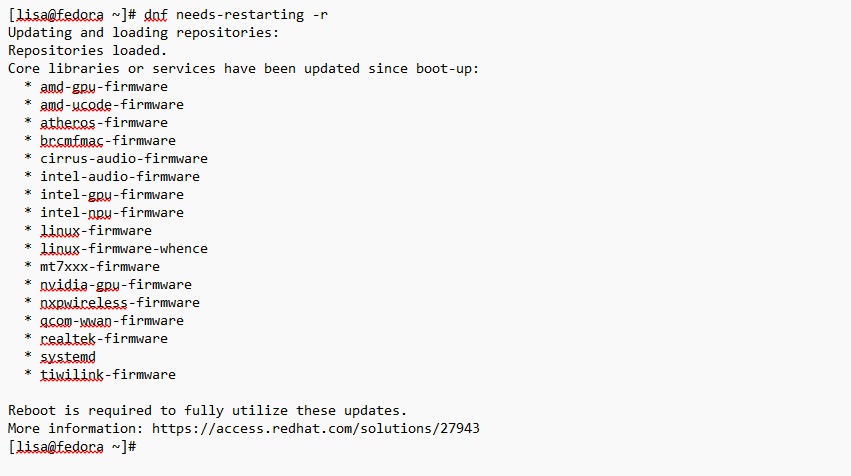
Fortunately, DNF will tell you if a restart is really needed. And which packages need the restart, too.
dnf needs-restarting will report packages that need a restart to be fully applied and `echo $?` is 1 when a restart is needed and 0 when it is not (for your automation and scripting use).
Corporate greed is an easy, convenient answer to why things are so expensive … but I’ve tracked profits and revenue for the global “big oil” companies for a while now. Other than Armaco, and generally Petrobras, profits are under 10% of revenue. “Record profits” seem, generally, to come from record sales. We’re not going through record high profit percentages.

Now, a company that “only” profited five billion dollars on 380b isn’t doing badly and could probably have gotten by if they only made 2 million – but that makes for an interesting study. Say oil is $100 per barrel. 380 billion dollars is 3.8 billion barrels sold (yes, I know many of these companies have other lines of business. This is a thought experiment, not a regulated financial filing). If they earned three billion dollars less that year, the price per barrel would only drop $0.79. Under 1% change. Now, if Armaco had only profited 3.4 billion last year instead of 93.4b, that would be a $20/barrel drop.
Raw data:
| Company | 2025 | 2024 | 2023 | 2022 | 2021 | 2020 | 2019 | 2018 | 2017 | 2016 | 2015 | 2014 | 2013 | 2012 | 2011 | 2010 | 2009 | 2008 | 2007 | 2006 | ||||||||||||||||||||
| Revenue ($B) | Net profit ($B) | Revenue ($B) | Net profit ($B) | Revenue ($B) | Net profit ($B) | Revenue ($B) | Net profit ($B) | Revenue ($B) | Net profit ($B) | Revenue ($B) | Net profit ($B) | Revenue ($B) | Net profit ($B) | Revenue ($B) | Net profit ($B) | Revenue ($B) | Net profit ($B) | Revenue ($B) | Net profit ($B) | Revenue ($B) | Net profit ($B) | Revenue ($B) | Net profit ($B) | Revenue ($B) | Net profit ($B) | Revenue ($B) | Net profit ($B) | Revenue ($B) | Net profit ($B) | Revenue ($B) | Net profit ($B) | Revenue ($B) | Net profit ($B) | Revenue ($B) | Net profit ($B) | Revenue ($B) | Net profit ($B) | Revenue ($B) | Net profit ($B) | |
| 1. Saudi Aramco | 446 | 93.4 | 481 | 106.2 | 495 | 121.3 | 604 | 161.1 | 400 | 110.0 | 230 | 49.0 | 330 | 88.2 | 356 | 111.1 | n/a | n/a | n/a | n/a | n/a | n/a | n/a | n/a | n/a | n/a | n/a | n/a | n/a | n/a | n/a | n/a | n/a | n/a | n/a | n/a | n/a | n/a | n/a | n/a |
| 2. PetroChina | 399 | 21.9 | 409 | 22.9 | 426 | 22.8 | 481 | 22.2 | 405 | 14.3 | 280 | 2.3 | 364 | 10.4 | 356 | 7.9 | 298 | 3.4 | 244 | 0.9 | 277 | 5.7 | 371 | 17.4 | 365 | 20.9 | 348 | 18.2 | 298 | 20.6 | 216 | 20.6 | 149 | 15.1 | 155 | 16.5 | 110 | 18.4 | 86 | 17.9 |
| 3. Sinopec | 388 | 4.4 | 428 | 7.0 | 454 | 8.5 | 493 | 9.9 | 435 | 9.5 | 305 | 4.8 | 430 | 8.3 | 437 | 9.2 | 349 | 7.6 | 291 | 7.0 | 324 | 5.3 | 459 | 8.8 | 465 | 10.3 | 457 | 10.1 | 388 | 9.8 | 283 | 9.3 | 197 | 8.6 | 209 | 6.8 | 157 | 7.0 | 131 | 6.4 |
| 4. ExxonMobil | 334 | 28.8 | 350 | 33.7 | 345 | 36.0 | 414 | 55.7 | 286 | 23.0 | 182 | -22.4 | 265 | 14.3 | 279 | 20.8 | 290 | 19.7 | 227 | 7.8 | 260 | 16.2 | 412 | 32.5 | 438 | 32.6 | 481 | 44.9 | 486 | 41.1 | 383 | 30.5 | 311 | 19.3 | 477 | 45.2 | 405 | 40.6 | 378 | 39.5 |
| 5. Shell | 274 | 17.8 | 289 | 16.1 | 323 | 19.4 | 386 | 42.3 | 273 | 20.1 | 183 | -21.7 | 352 | 15.8 | 397 | 23.4 | 312 | 13.0 | 240 | 4.6 | 272 | 1.9 | 431 | 14.9 | 460 | 16.4 | 482 | 26.7 | 484 | 30.8 | 378 | 20.1 | 285 | 12.5 | 458 | 26.3 | 356 | 31.3 | 319 | 25.4 |
| 6. TotalEnergies | 201 | 13.1 | 214 | 15.8 | 237 | 21.4 | 284 | 20.5 | 206 | 16.0 | 140 | -7.2 | 200 | 11.3 | 209 | 11.4 | 171 | 8.6 | 150 | 6.2 | 165 | 5.1 | 236 | 4.2 | 251 | 11.2 | 257 | 14.7 | 257 | 17.1 | 212 | 14.1 | 183 | 11.7 | 264 | 20.4 | 217 | 18.0 | 193 | 15.8 |
| 7. BP | 189 | 0.1 | 189 | 0.4 | 210 | 15.2 | 241 | -2.5 | 158 | 7.6 | 180 | -20.3 | 277 | 4.0 | 299 | 9.4 | 240 | 3.4 | 183 | 0.1 | 223 | -6.5 | 354 | 3.8 | 379 | 23.5 | 387 | 11.0 | 376 | 25.2 | 297 | -3.7 | 246 | 16.6 | 361 | 21.2 | 274 | 20.8 | 254 | 22.3 |
| 8. Chevron | 189 | 12.5 | 203 | 17.7 | 201 | 21.4 | 246 | 35.5 | 162 | 15.6 | 95 | -5.5 | 147 | 2.9 | 166 | 14.8 | 142 | 9.2 | 114 | -0.5 | 138 | 4.6 | 212 | 19.2 | 229 | 21.4 | 242 | 26.2 | 254 | 26.9 | 205 | 19.0 | 172 | 10.5 | 273 | 23.9 | 221 | 18.7 | 210 | 17.1 |
| 9. Rosneft | 101 | 3.6 | 109 | 11.7 | 107 | 14.9 | n/a | n/a | n/a | n/a | n/a | n/a | n/a | n/a | n/a | n/a | n/a | n/a | n/a | n/a | n/a | n/a | n/a | n/a | n/a | n/a | n/a | n/a | 92 | n/a | 63 | n/a | n/a | n/a | n/a | 11.1 | n/a | 6.5 | n/a | n/a |
| 10. Petrobras | 89 | 19.6 | 91 | 7.5 | 102 | 24.9 | 124 | 36.6 | 84 | 19.9 | 54 | -1.1 | 77 | 10.2 | 85 | 7.2 | 89 | 0.1 | 81 | -4.0 | 97 | -10.0 | 144 | -9.0 | 141 | 10.9 | 144 | 10.9 | 146 | 20.0 | 121 | 20.0 | 91 | 14.0 | n/a | n/a | n/a | n/a | n/a | n/a |
Data as available. Publicly traded companies in US and Europe are far more apt to have published , audited, probably somewhat accurate data.
This is amazing — and every one I’ve looked at so far includes a download option … https://3d.si.edu/explore
I’m still not sure if these were edible since I don’t eat anything I’m not super confident about identifying. These might have been golden oyster mushrooms … but they might have not been.


We’ve been running Cura from a flatpak because the rpm distributed version was out of date. The big drawback, though, is that this flatpak could not see the files from network mounts. The mount is fine – in fstab, same user account can interact with those files in other applications. Just not this flatpak thing.
Turns out that’s normal – flatpaks operate in a sort of sandbox. You just have to tell it to let an individual flatpak access the location where the network mounts are. In this case, the /mnt path:
flatpack override com.ultimaker.cura --filesystem=/mnt