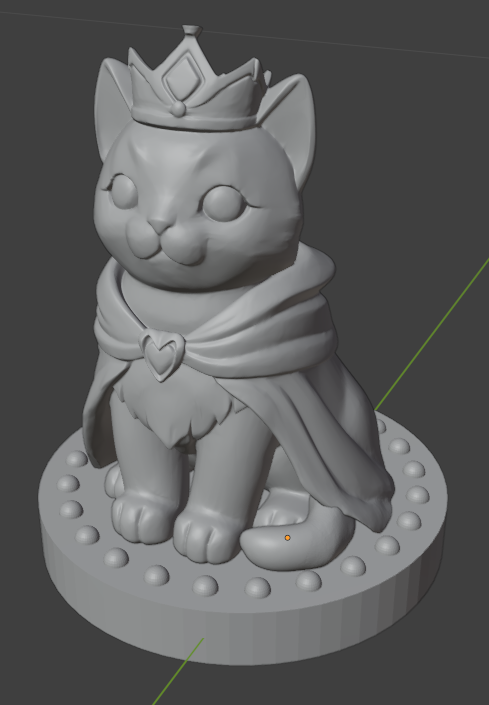
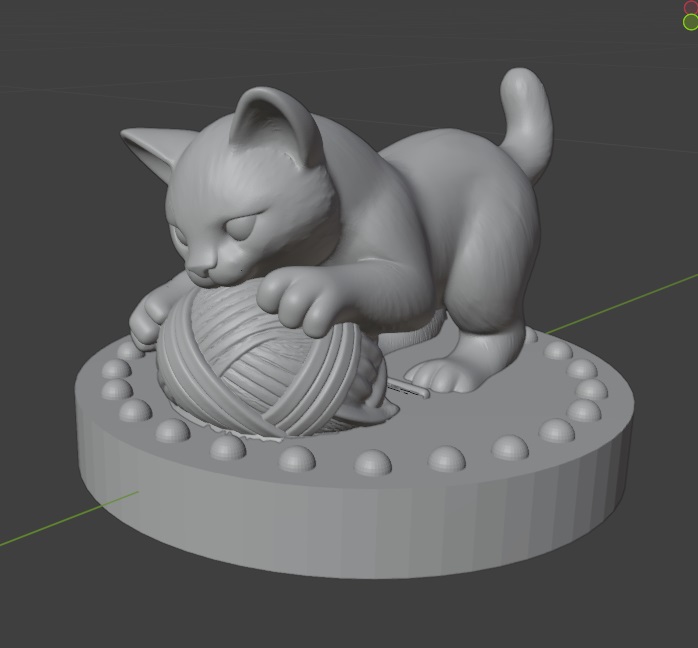
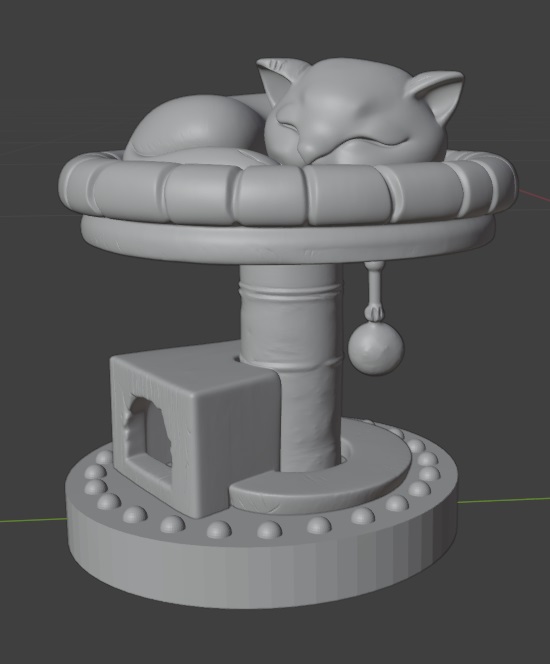
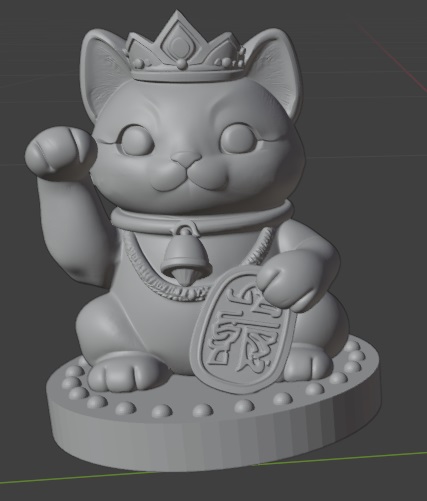
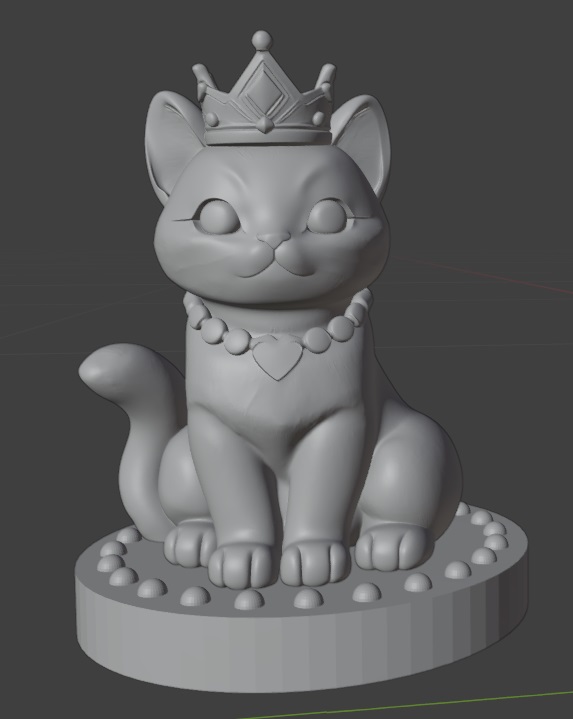
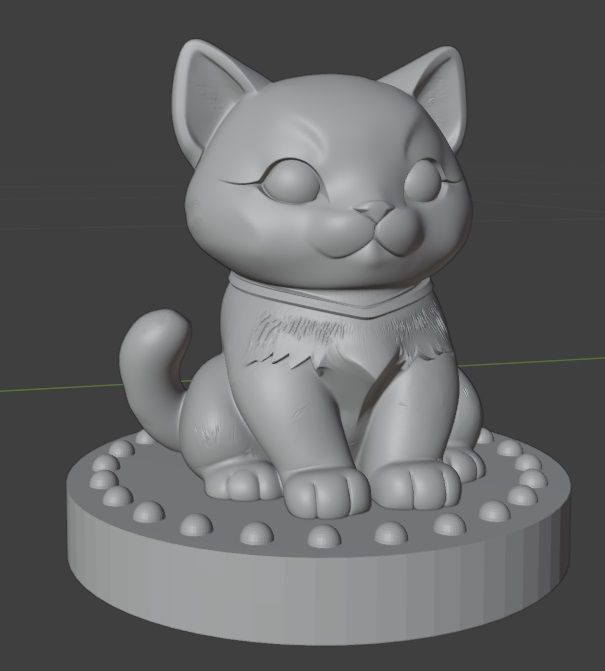
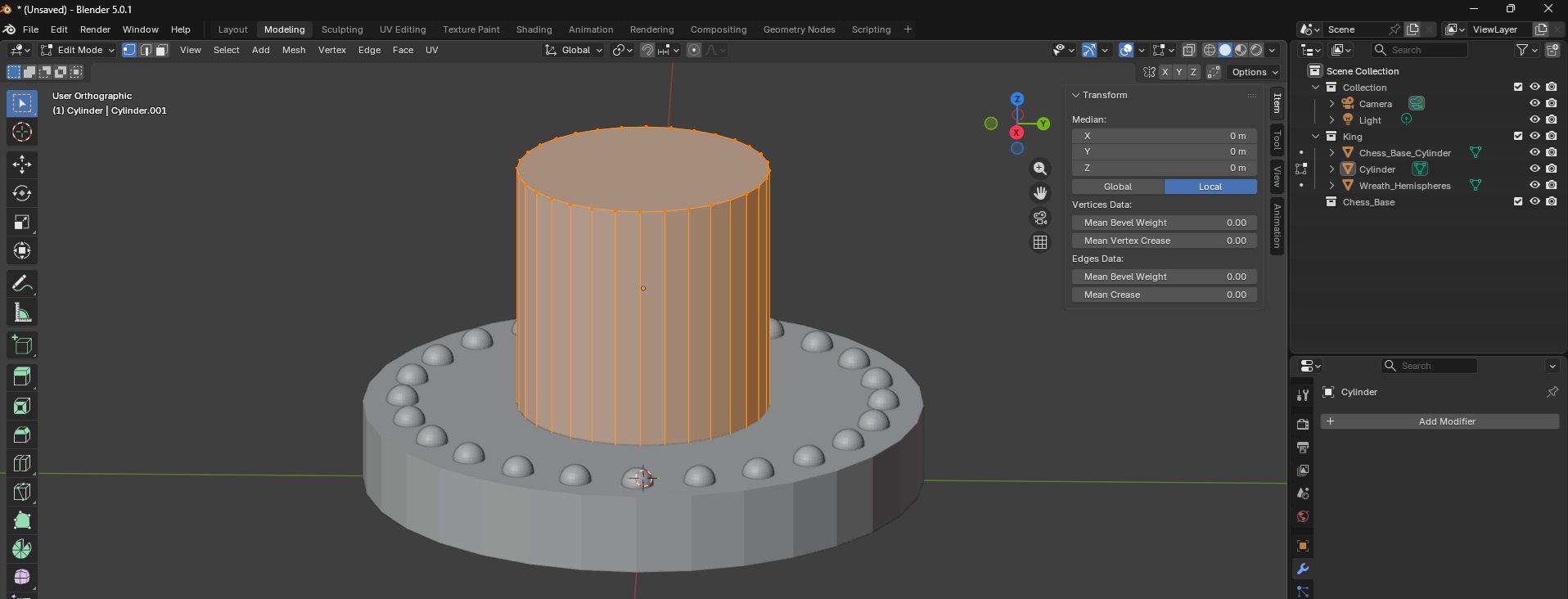
Originally, I wanted to sculpt the entire thing in python, but it appears that the programmatic interface only works in defined shapes. I guess I could construct millions of tiny triangles? polygons? to create cats … but I suspect that using the actual sculpting tools is going to be the easier approach.
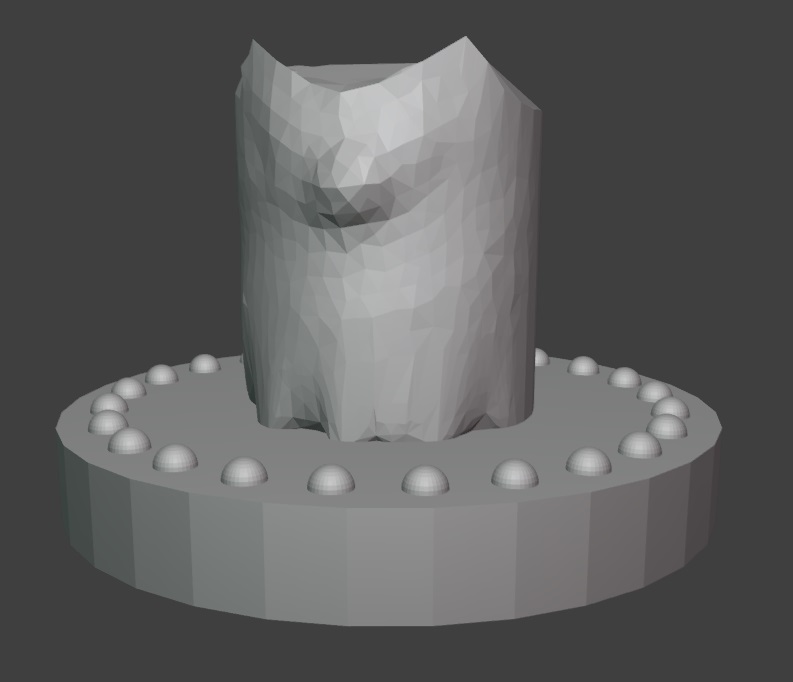
However, the base of each piece seems perfect for a script. This will ensure consistency in my chess pieces (and let me play around with the Python approach since I think it is really cool that Blender takes Python code!). I am making decorated cylinders onto which my figures will sit.
import bpy
import bmesh
import math

INCH = 0.0254  # meters per inch

params = {
    # Cylinder base size
    "base_diameter_in": 1.75,
    "base_height_in": 0.25,

    # Wreath hemispheres
    "hemi_count": 24,
    "hemi_radius_in": 0.05,
    "hemi_offset_in": 0.125,  # inward from base outer edge

    # Collection
    "collection_name": "Chess_Base",
}

def inch(v):
    return v * INCH

def ensure_collection(name):
    if name in bpy.data.collections:
        return bpy.data.collections[name]
    col = bpy.data.collections.new(name)
    bpy.context.scene.collection.children.link(col)
    return col

COL = ensure_collection(params["collection_name"])

def build_base():
    base_r = inch(params["base_diameter_in"]) / 2.0
    base_h = inch(params["base_height_in"])
    # Place the base so its top is at Z = base_h (sitting on Z=0 plane)
    bpy.ops.mesh.primitive_cylinder_add(radius=base_r, depth=base_h, location=(0, 0, base_h / 2.0))
    base = bpy.context.active_object
    base.name = "Chess_Base_Cylinder"
    # Link explicitly to target collection (in case active collection differs)
    if base.name not in COL.objects:
        COL.objects.link(base)
    return base

def make_hemisphere_mesh(radius_m, segments=32, rings=16):
    bpy.ops.mesh.primitive_uv_sphere_add(radius=radius_m, segments=segments, ring_count=rings, location=(0, 0, 0))
    sph = bpy.context.active_object
    bm = bmesh.new()
    bm.from_mesh(sph.data)
    # Keep the top hemisphere: delete vertices with z < 0 (tolerance to avoid floating error)
    to_delete = [v for v in bm.verts if v.co.z < -1e-7]
    if to_delete:
        bmesh.ops.delete(bm, geom=to_delete, context='VERTS')
    bm.to_mesh(sph.data)
    bm.free()
    hemi_mesh = sph.data
    hemi_mesh.name = "Hemisphere_Mesh"
    # Remove the temporary object but keep the mesh datablock
    bpy.data.objects.remove(sph, do_unlink=True)
    return hemi_mesh

def build_wreath_hemispheres(hemi_mesh):
    base_r = inch(params["base_diameter_in"]) / 2.0
    base_h = inch(params["base_height_in"])
    ring_r = base_r - inch(params["hemi_offset_in"])
    count = params["hemi_count"]

    hemis = []
    for i in range(count):
        theta = (i / count) * 2.0 * math.pi
        cx = ring_r * math.cos(theta)
        cy = ring_r * math.sin(theta)
        obj = bpy.data.objects.new(f"Hemi_{i:02d}", hemi_mesh)
        # Flat face of hemisphere (its equator at local Z=0) sits on base top (Z=base_h)
        obj.location = (cx, cy, base_h)
        COL.objects.link(obj)
        hemis.append(obj)

    # Join hemispheres into a single object
    bpy.ops.object.select_all(action='DESELECT')
    for o in hemis:
        o.select_set(True)
    bpy.context.view_layer.objects.active = hemis[0]
    bpy.ops.object.join()
    wreath = bpy.context.active_object
    wreath.name = "Wreath_Hemispheres"
    return wreath

def build_all():
    base = build_base()
    hemi_mesh = make_hemisphere_mesh(inch(params["hemi_radius_in"]))
    wreath = build_wreath_hemispheres(hemi_mesh)
    print("Built:", base.name, wreath.name)

build_all()