So if you slap a cute name on a crime, it’s all OK?!? What do you think this guy would call murder one?
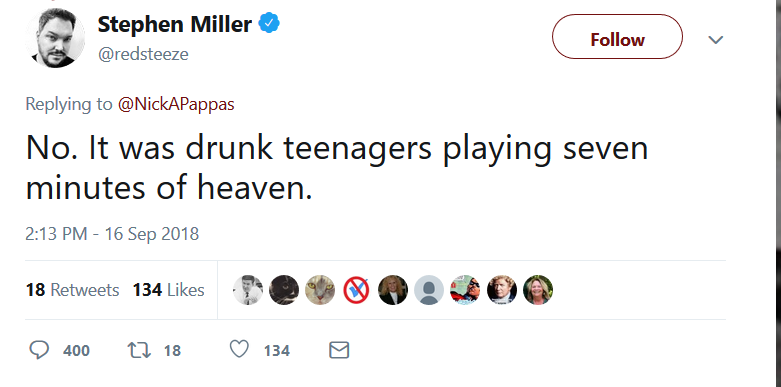
So if you slap a cute name on a crime, it’s all OK?!? What do you think this guy would call murder one?
There’s a challenge in teaching history to young people — whilst it is not good to proceed through life ignorant of what has come before you, there are facets of history that are simply incomprehensible to a five year old kid. Explaining why some people are afraid of the police, describing the point of the military … it is a snarl of sociological and political facts, individual experiences … there’s a good and a bad side, but it is difficult to understand points of view without the entire history that created that point of view (a bit like coupling Zinn’s People’s History with Johnson’s History of the American People and calling that a balanced history lesson). I used to advocate for the inclusion of fictional works in University history classes — while the story itself may not be true, fictional works provide a picture into the reality of the time. History provides a context for books, and books provide a context for history. Arthur Miller was not randomly enamored with the Salem witch hunts.
Sadly, Anya’s teacher has begun down the path of history without context. Today (why not yesterday!?!) she taught the kids that “bad people” crashed planes into buildings in DC and NYC, as well as PA. Which left me to try explaining that it’s not like half a dozen people woke up one morning and thought it might be a lark to try flying an aeroplane … only to find it wasn’t as easy as it looks on TV. It was an organized group executing a plan. It was also a group organized partially because of terrible things done across the globe. A cause can be just without justifying any action taken in support of the cause. The validity of a cause doesn’t make the action right any more than “he hit me first” makes slugging your brother right.
A lot of nation-states, countries, and people have done a lot of terrible things to one another in the name of just causes … the events of which the teacher spoke is an egregious example.
As an operational support group, we did not have a software development methodology. Doesn’t mean we didn’t develop software — one of the great things within operational support is the ability to automate day-to-day tasks to reduce workload. Why have someone check for application patches when a process can watch an RSS feed or file repository and notify us when there’s an update. Why have someone clickity-click provisioning users into groups when the user can make a web request, the group owner can approve the request, and an automated process can add the user into the group? The end result of our automation programming is, well, quite a bit of software.
And with a small number of people, informal application development worked. Wasn’t ideal, but it worked. If you want to write in Java while I use C# … not ideal, but the alternative is that one of us needs to learn a new programming language. Problem is the next guy we hired uses VBS, the next guy uses PowerShell … and I’ll use perl for simpler processes. Then someone starts tweaking my code and buggers it up … and we’ve got to figure out what happened and roll back based on some tape backup.
To get our internal software development processes organized, I developed a process. And ran a training session so everyone was familiar with both the process and the tools. Some of us have used the process well — don’t edit production code, clone the repo locally, make a branch for your edits, test it and have another group member sign off on the changes, merge your branch back into master, test more, then pull the code into production. The majority, it seems, have not followed the process at all. Changes are made to the code running in production, not incorporated into the Git repo. Six months after the new development process went in place, half of our code has improperly made changes!
To an extent, I consider this a management problem … if the department doesn’t want software development to be a free-for-all, then the department managers need to ensure their staff follows the process. If the department wants everyone to do their own thing — then get rid of the process and declare our methodology as “do whatever you want”. The challenge for managers, though, is that they don’t know that someone has edited code in production and failed to commit their changes into the repo. If only there were some way to watch for improperly edited code and alert us promptly.
Other scripts I’ve found to perform a similar function attempt to parse ‘git status’ to identify all sorts of issues — but that doesn’t address the specific problem that I’ve got. To facilitate identifying offenders, I wrote a quick Python script that searches a directory tree for git repositories and alerts us when changes have not been staged for commit. If you’ve staged the changes for commit, that won’t be identified. But the particular problem we encounter frequently … there are alerts for that.
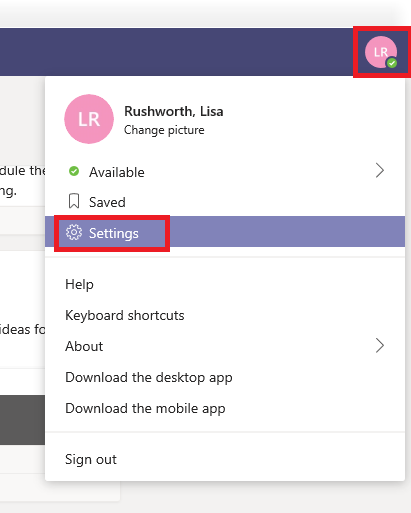
Click on your initials / picture in the upper right-hand corner of the screen and select “Settings”
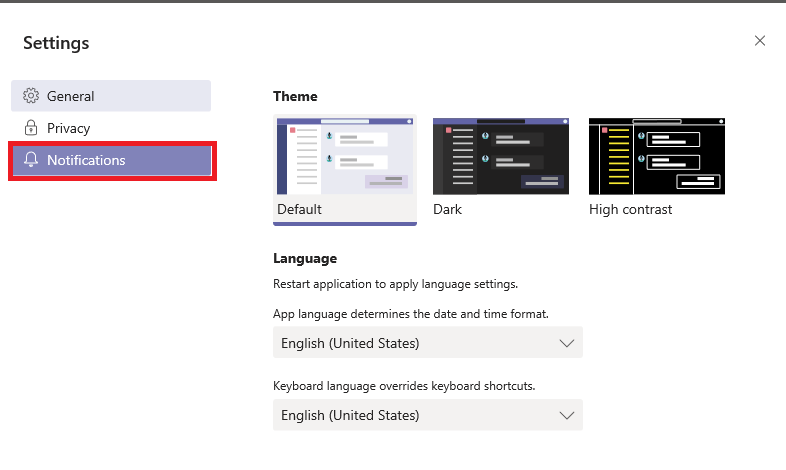
Within the Settings pane, select “Notifications”
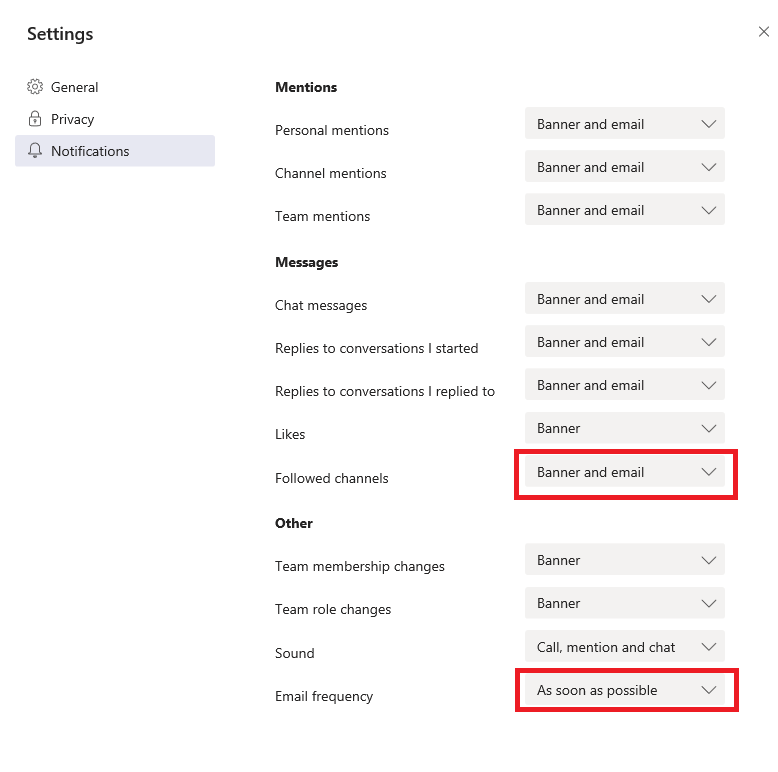
Change the “Followed Channels” notification to “Banner and email”; change the frequency to “As soon as possible”. Changes are saved as you make them. Use the “X” to close the Settings pane.
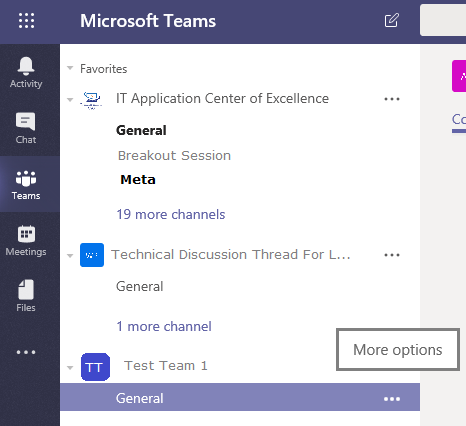
To receive e-mail notifications for a channel, follow it. Click the three dots to the right of the channel name.
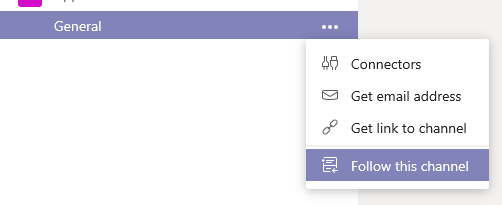
And click “Follow this channel”. If you click the three dots again, you can elect to “Unfollow this channel” and cease receiving e-mail notifications for posts to the channel.
You have to do this for each channel – if someone spins up a new channel, you won’t see notifications for those posts. I’ve been posting to the “General” thread whenever I break a discussion out into a new thread. This ensures anyone who wants e-mail notifications for the main thread at least knows there is a new thread that they may wish to follow.
** Microsoft’s algorithm for delivering e-mail notifications is a little … unique. Like most of these types of apps, an attempt is made to not deliver notifications for messages you’ve already seen. At last test, Microsoft used a 90-minute timer (not quite my definition of “ASAP”). If you have Teams open in a minimized web browser, if the notification went to your mobile client, if the notification went to your desktop client, if there were solar flares with peak flux over 10^(-5) W/m^2 … an e-mail notification is not sent. Point being, don’t rely on the e-mail notifications.
Ingredients
Method
Place everything in the bowl of a food processor and run until you’ve got a smooth paste.
To get really smooth hummus, I cook the garbanzo beans in a pressure cooker for about 35 minutes with at least 20 minute of natural depressurization.
********************************************************************************
Anya says these taste like peanut butter / chocolate / oat cookies. And it’s great for dipping anything that goes well with chocolate (strawberries, apples).
Saw an interesting note, after yet another school shooting, that said teachers eating lunch with students to maintain connection are able to identify individuals who could use intervention. Seems reasonable — I knew a few profs at Uni who ate in the student cafeteria instead of the faculty cafeteria. They were more engaged with the student body — kids would sit and chat with them, and rarely was the conversation limited to current class content.
Sometimes you need to provide your company e-mail address – registering for a conference or training class, signing up for an industry newsletter. Unfortunately, this can lead to an inundation of unwanted mail.
Exchange Online supports something called “sub-addressing” (so does Gmail … and you can test your email service’s support of this feature by sending yourself a message from some other source. If it gets delivered, you’re good. If not … bummer!). Sub-addressing allows you to slightly modify your e-mail address to customize it for every situation – between your last name and the ‘@’ symbol, put a plus and then some unique text. It will look like Your.N.Ame+SomeIdentifier@domain.ccTLD instead of Your.N.Ame@domain.ccTLD.
When signing up for a Microsoft newsletter, I can tell them my e-mail address is Lisa.Rushworth+MicrosoftSecuritySlate@domain.ccTLD … and messages to that address will still be delivered to me. When I sign up for the NANPA code administration newsletter, I can tell them my e-mail address is Lisa.Rushworth+NANPACodeAdmin@domain.ccTLD.
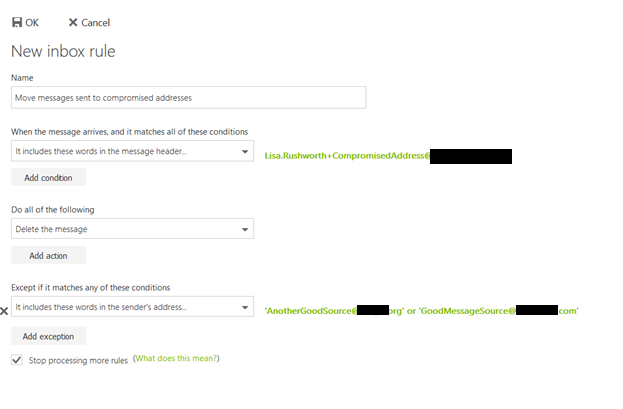
Should you start receiving unwanted solicitations to the sub-address, you can then create a rule to delete messages sent to that address.
You can also alert the person to whom you provided the address that their contact list may have been compromised … although my luck with that hasn’t been particularly good. Most companies deny any possibility that they might be the source of disclosure. Even when the address disclosed is Me+YourCompanyNameHere@… because that is something someone randomly generated. Sigh!
Why is it always too soon to discuss how gun control (or precluding those with mental illnesses from possessing guns) might have averted a mass shooting but it isn’t too soon to discuss how rounding up foreigners for mass deportation might have saved Mollie Tibbetts life?
I got Zoneminder 1.31.45 (which includes the new CakePHP framework that doesn’t use what have become reserved words in PHP7) working with the openHAB ZoneMinder binding (which relies on data from the API at /zm/api/configs/view/ATTR_NAME.json). There are two options, ZM_PATH_ZMS and ZM_OPT_FRAME_SERVER which now return bad parameter errors when attempting to retrieve the config using /view/. Looking through the database update scripts, it appears both of these parameters were removed at ZoneMinder 1.31.1
ZM_PATH_ZMS was removed from the Config database and placed in a config file, /etc/zm/conf.d/01-system-paths.conf. There is a PR to “munge” this value into the API so /viewByName returns its value … but that doesn’t expose it through /view.
ZM_OPT_FRAME_SERVER appears to have been eliminated as a configuration option.
You cannot simply re-insert the config options into the database, as ZoneMinder itself loads the ZM_PATH_ZMS value from the config file and then proceeds to use it. When it attempts to load config parameters from the Config table and encounters a duplicate … it falls over. We were unable to view our video through the ZoneMinder server.
*But* editing /usr/share/zoneminder/www/includes/config.php (exact path may vary, list the files from your package install and find the config.php in www/includes) to include an if clause around the section that loads config parameters from the database, and only loading the parameter when the Name is not ZM_PATH_ZMS (bit in yellow below) avoids this overlapping config value.
$result = $dbConn->query( 'select * from Config order by Id asc' );
if ( !$result )
   echo mysql_error();
   $monitors = array();
   while( $row = dbFetchNext( $result ) ) {
      if ( $defineConsts )
      // LJR 2018-08-18 I inserted this config parameter into DB to get OH2-ZM running, and need to ignore it in the ZM web code
      if( strcmp($row['Name'],'ZM_PATH_ZMS') != 0){
         define( $row['Name'], $row['Value'] );
      }
   $config[$row['Name']] = $row;
   if ( !($configCat = &$configCats[$row['Category']]) ) {
      $configCats[$row['Category']] = array();
      $configCat = &$configCats[$row['Category']];
   }
   $configCat[$row['Name']] = $row;
}
Once the ZoneMinder web site happily ignores the presence of ZM_PATH_ZMS from the database config table, you can insert it and ZM_OPT_FRAME_SERVER (an option which appears to have been removed at ZoneMinder 1.31.1) back into the Config table. **Important** — change the actual value of ZM_PATH_ZMS to whatever is appropriate for your installation. In my ZoneMinder installation, /cgi-bin-zm is the cgi-bin directory, and /cgi-bin-zm/nph-zms is the ZMS binary.
From a MySQL command line:
use zm; #Assuming your zoneminder database is actually named zm
INSERT INTO `Config` VALUES (225,'ZM_PATH_ZMS','/cgi-bin-zm/nph-zms','string','/cgi-bin-zm/nph-zms','relative/path/to/somewhere','(?^:^((?:[^/].*)?)/?$)',' $1 ','Web path to zms streaming server',' The ZoneMinder streaming server is required to send streamed images to your browser. It will be installed into the cgi-bin path given at configuration time. This option determines what the web path to the server is rather than the local path on your machine. Ordinarily the streaming server runs in parser-header mode however if you experience problems with streaming you can change this to non-parsed-header (nph) mode by changing \'zms\' to \'nph-zms\'. ','hidden',0,NULL);
INSERT INTO `Config` VALUES (226,'ZM_OPT_FRAME_SERVER','0','boolean','no','yes|no','(?^i:^([yn]))',' ($1 =~ /^y/) ? \"yes\" : \"no\" ','Should analysis farm out the writing of images to disk',' In some circumstances it is possible for a slow disk to take so long writing images to disk that it causes the analysis daemon to fall behind especially during high frame rate events. Setting this option to yes enables a frame server daemon (zmf) which will be sent the images from the analysis daemon and will do the actual writing of images itself freeing up the analysis daemon to get on with other things. Should this transmission fail or other permanent or transient error occur, this function will fall back to the analysis daemon. ','system',0,NULL);
Now restart ZoneMinder and the OH2 ZoneMinder binding. We’ve got monitors on the ZoneMinder web site, we are able to view the video stream, and OH2 picks up alarms from the ZoneMinder server.
If you re-run zmupdate.pl, it will remove these two records from the Config table. If you upgrade ZoneMinder, the change to the PHP file will be reverted.