It’s finally here! In Teams conversations, there’s now a button to start a new conversation thread and a place to click and type a reply to an existing thread. This should make it easier to keep messages in the thread in which you want them.

It’s finally here! In Teams conversations, there’s now a button to start a new conversation thread and a place to click and type a reply to an existing thread. This should make it easier to keep messages in the thread in which you want them.
I’ll prefix these instructions with a disclaimer – your company may have document retention in Teams. When you export your chat content, you’ll need to maintain appropriate retention policies yourself. In IT, we had a few information categories where retention was “useful life” – we could retain system documentation as long as the system was used. If you’re exporting a chat to keep something you are allowed to keep and then keep it outside of Teams … that’s awesome. If you are trying to keep something the company’s retention policy says should be removed … that’s probably not awesome.
Once you’ve determined that the info you are exporting is OK to export and maintain elsewhere, here’s how to export a Teams chat from within the Teams web client. Step 1, of course, is to lot into Teams at https://teams.microsoft.com and go to the chat you want to export. Scroll up to the top of the chat. If you have a really long chat, it may not be possible to export the entire thing using this approach. I might play around with it in the future, by most of my conversations are in Teams channels so I don’t have a chat that’s more than 30 or so messages.
Once you are at the top of the chat, open the developer tools (ctrl-shift-i in Chrome). Clear the errors — they clutter up the screen.

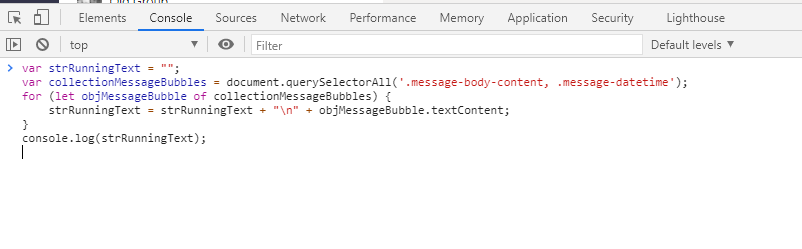
Paste the following script into the console and hit enter:
var strRunningText = "";
var collectionMessageBubbles = document.querySelectorAll('.message-body-content, .message-datetime');

for (let objMessageBubble of collectionMessageBubbles) {
     strRunningText = strRunningText + "\n" + objMessageBubble.textContent;
}

console.log(strRunningText);
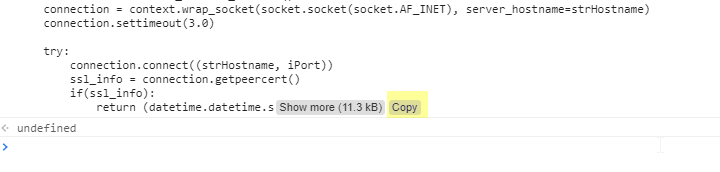
If you have a long series of chat messages, you’ll get some of the chat displayed and a button to copy the entire chat content to your clipboard.
If you have a shorter series of chat messages, you’ll have the text of the chat in the console window. You can highlight it and copy/paste the text elsewhere.
There’s a little cleanup that can be done – the content of the message-datetime elements have a beginning and trailing newline character along with a bunch of whitespace. You can get a cleaner timestamp (but, if you embed code within your messages … which I do … the code sections have a lot of extraneous newlines):
var strRunningText = "";
var collectionMessageBubbles = document.querySelectorAll('.message-body-content, .message-datetime');

for (let objMessageBubble of collectionMessageBubbles) {
     strRunningText = strRunningText + "\n" + objMessageBubble.innerText;
}

console.log(strRunningText);
The same JavaScript works in the Teams channel conversations except the channel conversations tend to be longer … so you’re going to export some subset of the channel conversation around where you are in the web browser.
* I realized, during a multi-person chat last week, that I don’t grab the name of the individual who posted the message to the chat. Grabbing the person’s name should just entail adding the identifier for the name element into the querySelectorAll list … but that’s not something I’ve had an opportunity to check yet.
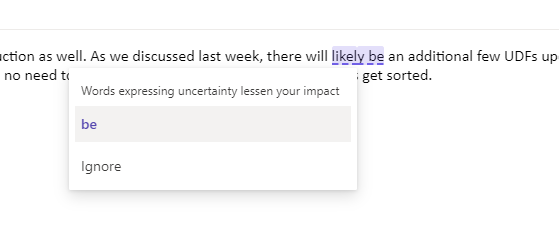
I noticed an enhancement in the Outlook Web message composition today — in addition to a spell checker and auto-complete, there is grammar advice.
Question — is it possible to dynamically determine the maximum page size when communicating with AD via LDAP? Since the page size (1) changed between versions and (2) can be user-customized … a guess is sub-optimal.
Answer — yes. If only the default query policy is used, search at
CN=Default Query Policy,CN=Query-Policies,CN=Directory Service,CN=Windows NT,CN=Services,CN=Configuration,*domain naming context* (e.g.
CN=Default Query Policy,CN=Query-Policies,CN=Directory Service,CN=Windows NT,CN=Services,CN=Configuration,DC=example,DC=com) with a filter like “(&(cn=*))”
Return the ldapAdminLimits attribute. Parse MaxPageSize out of the attribute:
lDAPAdminLimits (13): MaxValRange=1500; MaxReceiveBuffer=10485760; MaxDatagramRecv=4096; MaxPoolThreads=4; MaxResultSetSize=262144; MaxTempTableSize=10000; MaxQueryDuration=120; **MaxPageSize=1000**; MaxNotificationPerConn=5; MaxActiveQueries=20; MaxConnIdleTime=900; InitRecvTimeout=120; MaxConnections=5000;
To find all of the query policies, search at CN=Query-Policies,CN=Directory Service,CN=Windows NT,CN=Services,CN=Configuration,*domain naming context* for (&(objectClass=queryPolicy)) … either research a lot about query policies and figure out how to determine which applies to your connection or take the lowest value and know you’re safe.
Number of people represented by each rep in the Senate:
This is where I’d know small populations are over-represented. Two senators regardless of population — a state with a hundred residents would have two senators. Obviously we don’t have a state with a hundred residents — but the least populous states are the ‘best deal for residents’ list — lowest number of people represented by each Senator
| Size Rank | State | 2010 Population per Census | Senators | # Represented per Senator |
| 52 | Wyoming | 563,626 | 2 | 281,813.0 |
| 50 | Vermont | 625,741 | 2 | 312,870.5 |
| 49 | North Dakota | 672,591 | 2 | 336,295.5 |
| 48 | Alaska | 710,231 | 2 | 355,115.5 |
| 47 | South Dakota | 814,180 | 2 | 407,090.0 |
| 46 | Delaware | 897,934 | 2 | 448,967.0 |
| 45 | Montana | 989,415 | 2 | 494,707.5 |
| 44 | Rhode Island | 1,052,567 | 2 | 526,283.5 |
| 43 | New Hampshire | 1,316,470 | 2 | 658,235.0 |
| 42 | Maine | 1,328,361 | 2 | 664,180.5 |
And the most populous sates are the ‘worst deal for residents’ list — highest number of people represented by each Senator
| Size Rank | State | 2010 Population per Census | Senators | # Represented per Senator |
| 1 | California | 37,253,956 | 2 | 18,626,978.0 |
| 2 | Texas | 25,145,561 | 2 | 12,572,780.5 |
| 3 | New York | 19,378,102 | 2 | 9,689,051.0 |
| 4 | Florida | 18,801,310 | 2 | 9,400,655.0 |
| 5 | Illinois | 12,830,632 | 2 | 6,415,316.0 |
| 6 | Pennsylvania | 12,702,379 | 2 | 6,351,189.5 |
| 7 | Ohio | 11,536,504 | 2 | 5,768,252.0 |
| 8 | Michigan | 9,883,640 | 2 | 4,941,820.0 |
| 9 | Georgia | 9,687,653 | 2 | 4,843,826.5 |
| 10 | North Carolina | 9,535,483 | 2 | 4,767,741.5 |
Number of people represented by each rep in the House of Representatives:
But the apportionment in the House of Representatives isn’t as equitable as one might assume. It’s a different list of states under- and over- represented … but one rep from Rhode Island represents half a million people. One rep from Montana represents just short of a million people!
Best deal for residents — small number of people represented by each rep
| Size Rank | State | 2010 Population per Census | Reps | # Represented per Rep |
| 44 | Rhode Island | 1,052,567 | 2 | 526,283.5 |
| 52 | Wyoming | 563,626 | 1 | 563,626.0 |
| 39 | Nebraska | 1,826,341 | 3 | 608,780.3 |
| 38 | West Virginia | 1,852,994 | 3 | 617,664.7 |
| 50 | Vermont | 625,741 | 1 | 625,741.0 |
| 43 | New Hampshire | 1,316,470 | 2 | 658,235.0 |
| 24 | South Carolina | 4,625,364 | 7 | 660,766.3 |
| 21 | Minnesota | 5,303,925 | 8 | 662,990.6 |
| 42 | Maine | 1,328,361 | 2 | 664,180.5 |
| 13 | Washington | 6,724,540 | 10 | 672,454.0 |
Worst deal for residents — high number of people represented by each rep:
| Size Rank | State | 2010 Population per Census | Reps | # Represented per Rep |
| 45 | Montana | 989,415 | 1 | 989,415.00 |
| 46 | Delaware | 897,934 | 1 | 897,934.00 |
| 47 | South Dakota | 814,180 | 1 | 814,180.00 |
| 40 | Idaho | 1,567,582 | 2 | 783,791.00 |
| 27 | Oregon | 3,831,074 | 5 | 766,214.80 |
| 31 | Iowa | 3,046,355 | 4 | 761,588.75 |
| 25 | Louisiana | 4,533,372 | 6 | 755,562.00 |
| 28 | Oklahoma | 3,751,351 | 5 | 750,270.20 |
| 18 | Missouri | 5,988,927 | 8 | 748,615.88 |
| 32 | Mississippi | 2,967,297 | 4 | 741,824.25 |
Electoral College:
The combination of which yields the over and under representation in the Electoral College (and the reason I think the National Popular Vote Interstate Compact is such a good idea).
Best deal:
| Size Rank | State | 2010 Population per Census | Electoral Delegates | # Represented per Delegate |
| 52 | Wyoming | 563,626 | 3 | 187,875 |
| 51 | District of Columbia | 601,723 | 3 | 200,574 |
| 50 | Vermont | 625,741 | 3 | 208,580 |
| 49 | North Dakota | 672,591 | 3 | 224,197 |
| 48 | Alaska | 710,231 | 3 | 236,744 |
| 44 | Rhode Island | 1,052,567 | 4 | 263,142 |
| 47 | South Dakota | 814,180 | 3 | 271,393 |
| 46 | Delaware | 897,934 | 3 | 299,311 |
| 43 | New Hampshire | 1,316,470 | 4 | 329,118 |
| 45 | Montana | 989,415 | 3 | 329,805 |
And the worst deal
| Size Rank | State | 2010 Population per Census | Electoral Delegates | # Represented per Delegate |
| 1 | California | 37,253,956 | 55 | 677,345 |
| 3 | New York | 19,378,102 | 29 | 668,210 |
| 2 | Texas | 25,145,561 | 38 | 661,725 |
| 4 | Florida | 18,801,310 | 29 | 648,321 |
| 5 | Illinois | 12,830,632 | 20 | 641,532 |
| 7 | Ohio | 11,536,504 | 18 | 640,917 |
| 10 | North Carolina | 9,535,483 | 15 | 635,699 |
| 6 | Pennsylvania | 12,702,379 | 20 | 635,119 |
| 11 | New Jersey | 8,791,894 | 14 | 627,992 |
| 8 | Michigan | 9,883,640 | 16 | 617,728 |
Divide by Zero Error
None of which speak to the almost five million people who are unrepresented in the Legislature. Or the just short of one million people who aren’t even represented in the Electoral College.
| Size Rank | State | 2010 Population per Census | Reps | # Represented per Rep | Senators | # Represented per Senator | Electoral Delegates | # Represented per Delegate |
| 29 | Puerto Rico | 3,725,789 | 0 | #DIV/0! | 0 | #DIV/0! | 0 | #DIV/0! |
| 51 | District of Columbia | 601,723 | 0 | #DIV/0! | 0 | #DIV/0! | 3 | 200,574 |
| 53 | Guam | 159,358 | 0 | #DIV/0! | 0 | #DIV/0! | 0 | #DIV/0! |
| 54 | U.S. Virgin Islands | 106,405 | 0 | #DIV/0! | 0 | #DIV/0! | 0 | #DIV/0! |
| 56 | Northern Mariana Islands | 53,883 | 0 | #DIV/0! | 0 | #DIV/0! | 0 | #DIV/0! |
| 55 | American Samoa | 55,519 | 0 | #DIV/0! | 0 | #DIV/0! | 0 | #DIV/0! |
And the spreadsheet, in case it’s useful to someone else.
Shelf mushrooms growing on a tree stump in the woods

Anya keeps telling me that chickens grow up so fast … which is both true and so funny coming from the Anya who also seems to grow up really fast. The little balls of fluff are half feathers now, and getting bigger (and more chicken-like) every day. We had our first escape yesterday. I’d clipped a mesh over the top of the brooder when they first started fluttering. But one of the dark-feathered birds was roosting on top of the chicken toaster and pushed her way out of the cover. Now we’ve got more clips, and it seems to be secure.
And they love going outside to play. We’ve had a few really busy days and haven’t been able to take them out. Tomorrow looks a little cool, but the weekend and the first few days next week look like perfect chicken playing weather.

Anya’s online school includes physical education — they provide ideas for games we can play, and we we tweak the idea. Last week, they wanted us to stand on one foot and play catch with a ball. That turned into a cross between volleyball and tennis. The activity this week was to draw a few chalk figures (circle, triangle, line, zig-zag) and pretend those are a tightrope. Anya turned it into a race — you start by running along the long line, leaping to the triangle, following it and then leaping to the circle, running along the circle, jumping to the next circle and running along it, then leaping over to a short line that gets you to the zig-zag. There was a lot of running into each other (especially when she added the “go either direction around the shape” rule), and it was really hard to win if you didn’t want to run over the tiny person. Which makes it one of Anya’s favorite games.