Speculation — Why he didn’t release his taxes

I’ve long speculated that Trump doesn’t release his taxes because beyond paying zero dollars (which everyone pretty much expects), he’s taking refundable deductions and having the government pay him. Well, the NYTimes has finally gotten access to years of returns for Trump and his businesses … and I’ve got a new hypothesis. It was only time before someone with access to Trump’s taxes sent that info to reporters. Had he stayed a private citizen, no one would have cared. And people who could have accessed the documents wouldn’t have bothered — they weren’t important.

The “loss” he claimed and carried back to request a 70 million dollar refund is questionable. If he got interest in the reformed company, he didn’t actually walk away from the investment. Before the tax returns were publicized, no one knew that the details of the subsequent transactions were of interest. Now that it’s public? Someone has access to information that’s pertinent to the IRS investigation. It’s only a matter of time before those details are splashed across some news paper’s page.

iJEMS Primer

The online docket site is located at http://www.co.medina.oh.us/medct_epublicnodr/UserLogin.aspx

Select “Public User Click Here” to enter the site.

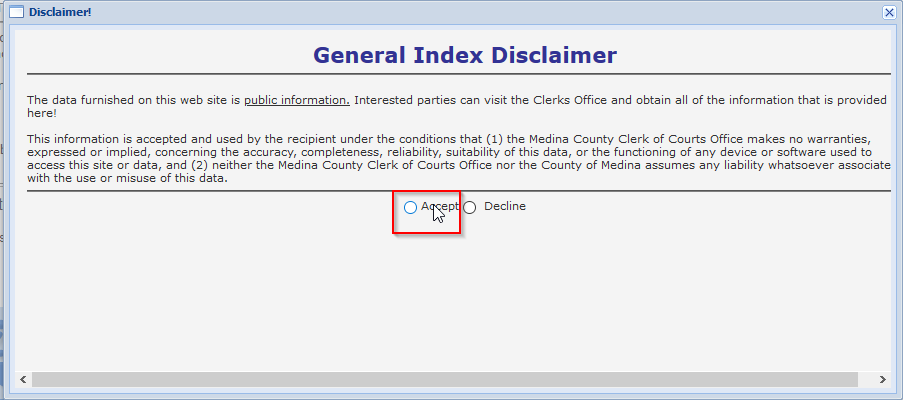
Read the disclaimer; and, if you agree to the conditions, click “Accept”

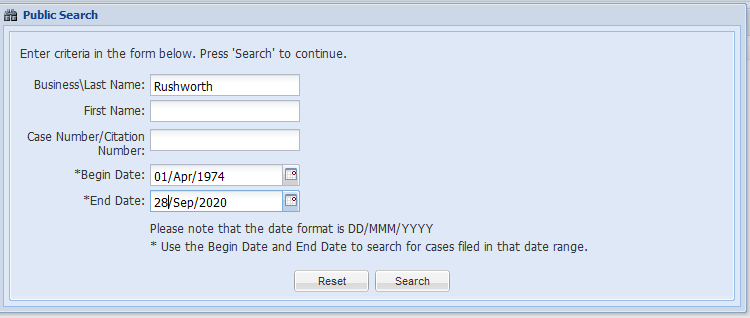
Enter some search criteria – you can use a wildcard search (e.g. I wanted to find all of the Board of Zoning Appeals cases) or an exact name. By default, the date range is what I assume is their first record through today. Adjust as needed. Click “Search” to proceed.

You’ll get a list of matching cases. Click on one of the case numbers to view the case details.

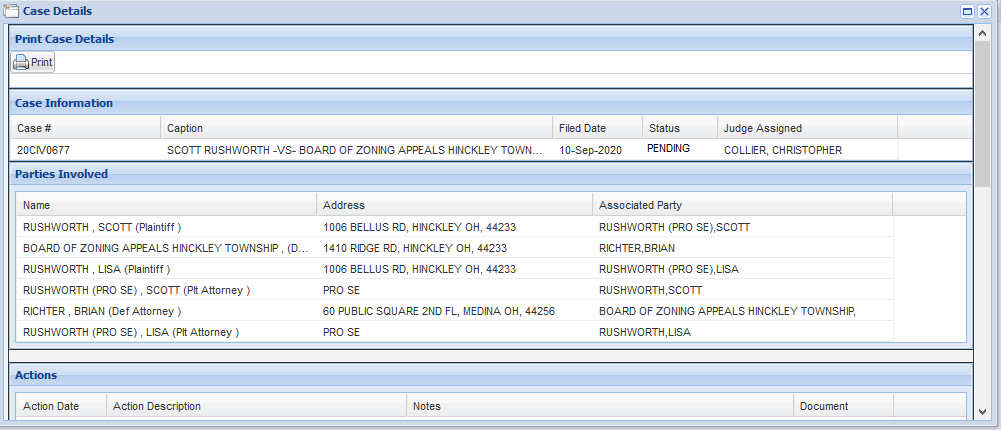
You’ll see a case summary at the top of the window that appears. This will tell you the official case name, when it was filed, and the status. This is followed by a list of all of the parties involved.

Scroll down in that window to the “Actions” section, and you will see the case documents. Some will say “No Document” – for example, the case being filed is a record in the docket, but there’s no document. It’s just an event. Most items, however, will have a hyperlink that says “View” that can be used to open a PDF copy of the document.


On Taxes and Businesses

I expect a lot of hype about how little Trump paid in taxes — and, yeah, it really sucks that someone is able consider private planes, meals, club memberships, car leases, etc to be a tax-deductible business expense. One of my first introductions to the working world was a privately-held company. I was the IT department, and one of my jobs was to move data from the old systems (mainframe for order management, database for inventory, and paper ledger for accounting) into the new all-in-one business management platform. Which meant I not only had access to all of the company’s accounting, but that I had to read through it all to get the information typed into the new platform. The company owner’s plane was owned by the business, so the hangar and maintenance was a business expense. He’d hire time in the plane for person use, but he got a really good discount from his company’s transportation service. Same for the company car he drove. And the country club membership — that’s where he’d meet with clients to solicit business, after all. Food and drink at those client meetings were business expenses too. It was all perfectly legal and designed both to maximize the owner’s enjoyment of life and the minimize the business’s profits. As a broke out-of-college kid, it seemed awfully unfair that the rich old dude was able to eat every day and avoid paying some taxes in doing so but the huge chunk of my paycheque that went to various taxes meant I had some rice to eat that day.

There were subordinate companies that paid consulting fees back to the main company to zero out any profits they made. And that parent company had a bunch of “business expenses” that minimized their profits. Ideally, the CFO told me, you’d net zero every year (or even have a paper loss) and not have to send the federal government anything in business taxes. Which I get — people shop around for the best price, find coupons and promo codes … you try to get the best deal. And, if the legal structure allows you to do so, why wouldn’t you avoid paying taxes altogether?

I’ve heard people say that a business needs to show a profit every ten years — that’s not true. If you don’t show a profit once in a ten year period, you may be asked to prove to the IRS that it’s a legit business. I come across this in the soap-making community — buying stuff for my soap-making hobby is not tax deductible even if I construct a business entity under which to make those purchase. Even if I happen to sell a few bars of soap to friends and neighbors. But if you’re advertising your product, going out to craft fairs and selling your soap … you provide the IRS evidence of your attempts to sell your product and you could be losing money every year for decades and still write off business expenses.

And the tax code is designed to encourage businesses to minimize their net — investing in your business offsets profit too. It’s one of the biggest problems I had with the interaction Obama had with Joe the not-a-plumber. If you buy a plumbing business that grosses a million dollars a year? You hire another plumber, buy another truck … you invest in a new tool that lets you offer more services. You spend some of that money and don’t have to pay taxes on it. Well, that hiring and purchasing also improves the country’s economy.

Hop Garlic Marinade

Hop Garlic Marinade

Recipe by LisaCuisine: AmericanDifficulty: Easy
Prep time

10

minutes

Ingredients

  • 304 cloves garlic

  • 1/2 cup olive oil

  • 2-3 Tbsp hop tea

  • 1 tsp honey

  • 1 tsp salt

  • 1/2 tsp pepper

  • 1/2 tsp Aleppo Pepper

Method

  • Whirl everything in a food processor until emulsified.

Electric Brewing Research

We saw a DigiBoil at the local homebrew shop when we stopped by to pick up yeast. Scott had been pricing out a three-kettle system with pumps (along with some sort of table) and it wasn’t cheap. The DigiBoil was about 200 bucks. I took a quick picture of it to research later. Quickly discounted it as an option because it’s just a big pot with electric elements to boil water. We needed something for mashing too.

At which point we decided to shop around and see what other options were available. There’s the Grainfather — super expensive and, if I wanted to walk away while it cooked, I’d want to go farther than Bluetooth range. We came across Brewzilla — the software controls of a Grainfather minus connectivity, but 650 bucks is a lot more reasonable for a 65L brewing platform. Unfortunately, the 3.1 version starts the timer when the elements kick in to reach that temperature. Version 3.1.1 systems change this logic so the timer starts once the temperature is reached. The control board can be swapped out, but I really don’t want to blow fifty bucks upgrading something I bought this week. And, while there were some 65L 3.1.1 Brewzilla’s hit the US at the start of 2020, suppliers are all awaiting delivery “late summer 2020”, “late September 2020”, or “Autumn 2020” … which I took to mean “we don’t know when”. Understandable, but pretty much put the Brewzilla out of the running.

I came across a Mash & Boil — a 35L system with re-circulation pump is about 350. Decent price, but there’s no 65L system. Same with the Anvil Foundry — where a 6.5 and 10.5 system are available.

In looking at the Brewzilla, I found a mash upgrade kit for the DigiBoil. And a kit which includes both the mash upgrade and DigiBoil called a DigiMash. Both a 120V and a 240V 35L DigiMash are available, as well as a 240V 65L system. At around 240 bucks for the 240V 35L system, it’s a great deal compared to a three-kettle system. Because we frequently do double batches and potentially recipes with larger grainbills, the 18 pound capacity was limiting. At 340 bucks for the 65L DigiMash, it sounded like a great deal. No re-circulation pump, but it’s easy enough to hook a pump up to the output valve. Brewzilla has a port in the bottom of the vessel that goes down to a pump under the unit — a short silicone tube connects to the pot and another short silicone tube that connects to the metal fitting through the side-wall of the vessel. On the video we found, that tube was pretty cruddy looking … which isn’t exactly a selling point.

DigiMash doesn’t have the software-control of Brewzilla — you can set a 158F mash temp and come back and hour later, but you cannot perform step mashing. Which … not something we’ve done. And, really, you could. You’d just have to change the temps manually. It sounds like an interesting experiment to put together an ESP12e and a few relays to control the elements. Potentially, we could turn the DigiMash into an open source customizable controllable (and WiFi connected) brewing system.


Cinnamon Sugar Almonds

Cinnamon Sugar Almonds

Recipe by LisaCourse: SnacksDifficulty: Easy
Prep time

15

minutes
Cooking time

30

minutes

Ingredients

  • 2 egg whites

  • 2 tbsp vanilla extract

  • 4 cups unblanched almonds

  • 2/3 cup coconut sugar

  • 1 tsp salt

  • 1/2 tsp ground cinnamon

Method

  • Preheat oven to 300 F
  • Beat egg whites until frothy; beat in vanilla. Add almonds and stir to coat.
  • Combine sugar, salt, and cinnamon. Add to nut mixture and stir gently to coat.
  • Spread evenly on a baking tray and bake for 15 minutes. Stir and bake for another 10-15 minutes (until crispy).

Propublica Climate Change Impact Predictions By County

Propublica has climate change impact predictions, but the county-level data is not particularly useful for data mining. You can sort individual columns, but it’s not possible to filter out data or sort by multiple criteria. I dropped the data into an Propublica Climate Impact Modeling Excel Spreadsheet to make it more usable. We’ve been talking about buying a couple hundred acres somewhere in the next 5-10 years … and I wanted to identify good long-term prospects (i.e. don’t want to move somewhere only to find that heat, humidity, drought, or wild fires make it an untenable location)

Flavored Sparkling Water – Hops

I got a bunch of flavoring to make carbonated flavored water. In the process of researching all-in-one electric brewing systems, I happened across a recipe to make a *hop* sparkling water!

Boil water for 10 minutes to sterilize. Chill to 170 degrees. Add a bit of lemon or lime juice to drop PH to 4.6. Add ~2 grams of hops per gallon of water and let stand 20 minutes to make a hop tea. Filter out hops. Keg hop tea and carbonate. Voila, hop soda.

2020 Hop Harvest

The 2020 hop harvest is in. The centennial produced a handful of hops that I’ll use in a barbecue sauce. We got about 44 ounces of cascade — much of which will be used in the 2020 fresh hop beer. The new baby plants we got this year got to set their roots, and hopefully we’ll see some cones next year. I cannot wait to try some Medusa!

Low Carbon Footprint Future

A friend asked what people thought a sustainable lifestyle for Americans would look like.

Hopefully we go the route of larger, centralized change. Power producers move to renewable sources. I thought work-from-home would be a big thing from a resource usage reduction standpoint — I drive a couple of miles a week on average. Technology is there to support it for a lot of people, but it took a pandemic shutdown to actually get people working from home. Hopefully that sticks as a post-pandemic norm. Food production is a huge one to me — even if the entire population drastically reduces meat consumption, mainstream agricultural practices are still destructive.

On an individual level? There will need to be a lot of adjustments to what constitutes “normal”. More preserved foods (I mean naturally like the canned/pickled stuff) to reduce the need for refrigeration (there are 34 cubic ft refrigerators that pull like 850kWh a year!!!). Product availability too. I like banana and mango; but, short of figuring out how to have a banana tree in a walipini, that’s silly stuff to be eating regularly in Ohio.

What people envision as a “lawn” changes. The amount of resources, time, and effort it takes to sustain non-native grass plants … such a waste. Long term, I hope to see taller plants becoming socially acceptable … but I’d love to see a move away from the broad spectrum herbicide / fertilizer / constant watering approach to turf management even if someone is still mowing it every week.

Expectations around landscaping change to focus on edible landscaping — I’ve seen some people create visually stunning landscaping that produces fruits, nuts, and veggies. Since a lot of resources go into growing, transporting, and storing foods … anything that increases local production seems like a good direction. And it’s not like it’s harder to maintain a wall of flowering vines that happen to produce beans than a wall of vines that happen to produce … non-edible seeds for more flowering vines.

Single-stream recycling goes away. Yes, it’s a pain to separate colored and clear glass, metal cans, different numbered plastics, etc. But what we’ve got now is a lot of broken glass shards, unusable paper and cardboard, and plastics littering up a lot of other countries. No more kaolin clay on paper either — piles of that anywhere that’s been buying up Western recyclables. But seeing a glossy page in a magazine or a glossy advertisement in your mailbox will make you wonder how that company could be so irresponsible.

Used goods become more socially acceptable. The resources to manufacture something are a sunk cost. Maximize the useful life of products and the benefit from that fixed cost goes up. I remember my sister getting snippy with my mom for gifting her kids “used clothing”. It was clean, undamaged … perfectly serviceable clothing. Babies outgrow clothing too quickly to wear stuff out. Stain it, sure. But that’s easy enough to avoid. The resources that go into making a little shirt that a kid can wear for three months is astonishing if you think about it. And it makes total sense for six different kids to get use out of that resource expenditure. The one dealership around here has a 20 year warranty on their cars — and people drive the thing for a three year lease! A corollary to this is the eliminating the expectation that something’s going to fail in a year or two. Consumer pressure on manufacturers to spend the extra buck to make a long-lasting product that works for a decade or three (or will have a decent resale value if I only use it for a year). Same for fixing things — which may mean the return of local repair shops (when was the last time you got a vacuum repaired?) or may mean people learn to fix stuff themselves.

Commercialized re-use — I got an arctic fleece that’s made from plastic bottles & the company is set up to take back their fleece material, melt it down, and run it back through the production line. IIRC, they would cover shipping it back. Totally doing that with the jacket I made my daughter when she outgrows it. She had a little blurb in one of her school books last year about a company collecting used gum in containers along the streets and making stuff (rain boots!) from the used gum. I got a whole ewwwww! thinking about it … but realistically, it’s processed. I’m certain a lot of companies could have us ship back their products, do something, and turn it around into a new product. My ideal world would have people recycling plastic at home into 3d printer resin … but that’s a long way from mainstream.

Shared resources are something I don’t see becoming popular for most items. Unfortunate since the seven houses in my neighborhood could all share a single set of yard tools. But normalized work/weekend times mean *everyone* would have needed the mower on the sunny Saturday this week. Routine maintenance is one thing – predictable and easily divided out. But you go to pull the chainsaw out of the common shed and find the chain broken … buying your own chainsaw looks more appealing. Hiring out more services achieves a similar material reduction. Transporting the mower around is a resource drain, but one person with one piece of equipment can cut the lawns of a few dozen people. I could see service providers start advertising the environmental benefits of using their services — and people happily picking that up as the Right Thing To Do (with bonus extra free time).

There’s certainly efficiency to a lot of people living in small apartments — we could construct, maintain, heat, and cool the same 50k sq ft of space and support 25 people with 2k sq ft flats or 100 people with 500 sq ft flats. Possibly moving to more shared spaces coupled with efficiency-style flats — bit of a cultural shift to be relaxing, cooking, etc in communal spaces, but it’s certainly a more efficient use of space. Breaking buildings up into smaller flats may well increase population density. Potentially straining infrastructure (Atlanta traffic in the early 2000’s), water resources (may not currently be a problem in a lot of cities, but think about Cape Town with *more* people crammed in there) … and increased population density within cities might appeal to those already living in an urban environment, but it’s a nightmare scenario for people who like living in rural areas. Can make a sales pitch for living in a rural area too: some of an individual’s environmental impact comes from their food consumption. Not much is growing in the tiny flat, even if the complex does a community garden on the roof. The proliferation of “victory gardens” is big in my picture of reduced carbon footprint life.

I’m thinking developers start to include shared utility systems — most people I know who live in the suburbs don’t have enough space for geothermal HVAC or solar/wind farms. But the HOA could own a loop field run along roads and green-space areas. Hook up to the loop field like you would water or gas. The HOA could own alt energy facilities that produce energy for the neighborhood. Including a community garden in the development plan. Then again, I thought HOA’s would take over channel assignment for WiFi networks … I may vastly overestimate both the things about which people are willing to cede control and underestimate the number of things the HOA board wants to enforce. To some extent, apartment complexes could do the same thing — solar roof and windows, geothermal under the carpark (yeah, you run the risk of a leak meaning the carpark is ripped up … there are logistics to think through). Far more efficient construction either way — half of my house is underground & I basically cool it to cut down on humidity. Stays around 50 without heat in the winter too … which is uncomfortably cold, but I’ve always been curious what I could maintain with no energy input if the *whole* house was underground.

Problem is … I doubt many of these changes are ones people will make voluntarily. It’s less fun, less convenient, costs more (and I don’t mean to say time and money aren’t legit concerns — just that they are barriers to adopting a less impactful lifestyle). Which brings me to the apocalyptic (non-voluntary and quick) return to pre-industrialized interactions with the planet after massive environmental catastrophe option. Which is essentially the “do nothing” approach. I mean, I can blow 50k on solar/wind/batteries, run my geothermal heat off of said alt energy sources, drive the same electric car I’ve had for a decade, convert my property into a sustainable farm. Not buy any new stuff — maybe start growing cotton and get some sheep so I’m making my own clothes. 3D print with plastics I pick up from recycling centers. All sorts of extreme changes. Drop in the bucket as far a global environmental impact goes. And it’s not like it’s a set of changes that scales well. No changes for some time … then no one will be buying stuff because there’s no store. Or petrol to get there. Or electrical grid to power it. You’ll be eating what’s scavenged or produced within a few miles of your house because that’s all that’s available. Patching up that old sweatshirt because the alternative is no shirt.