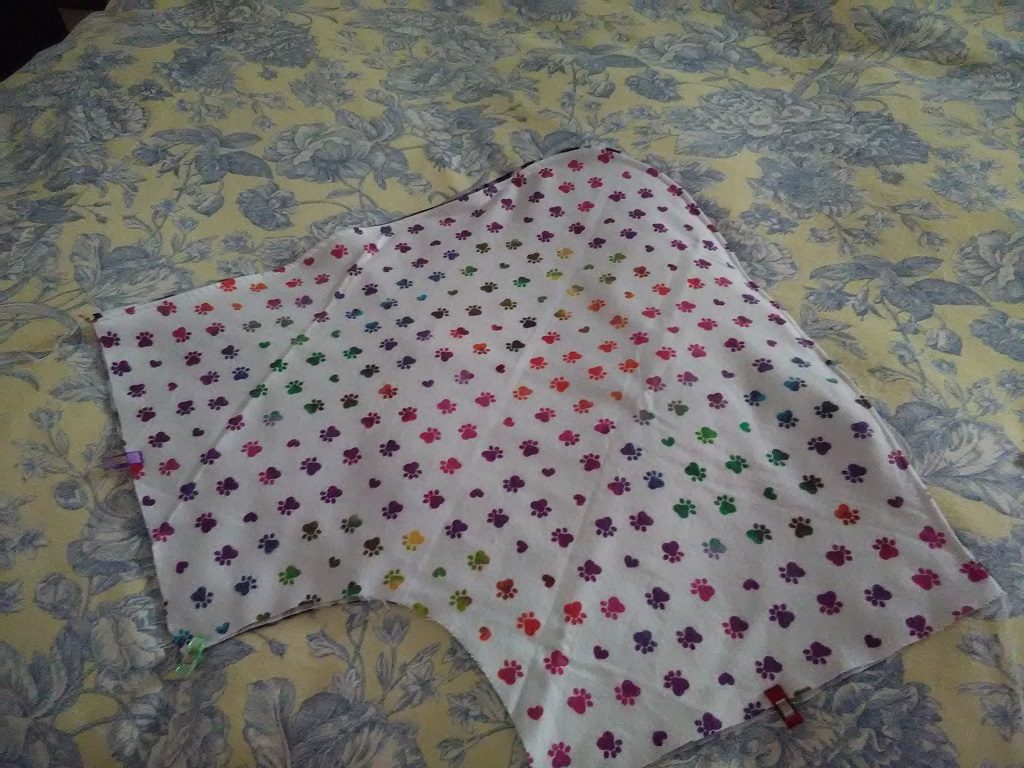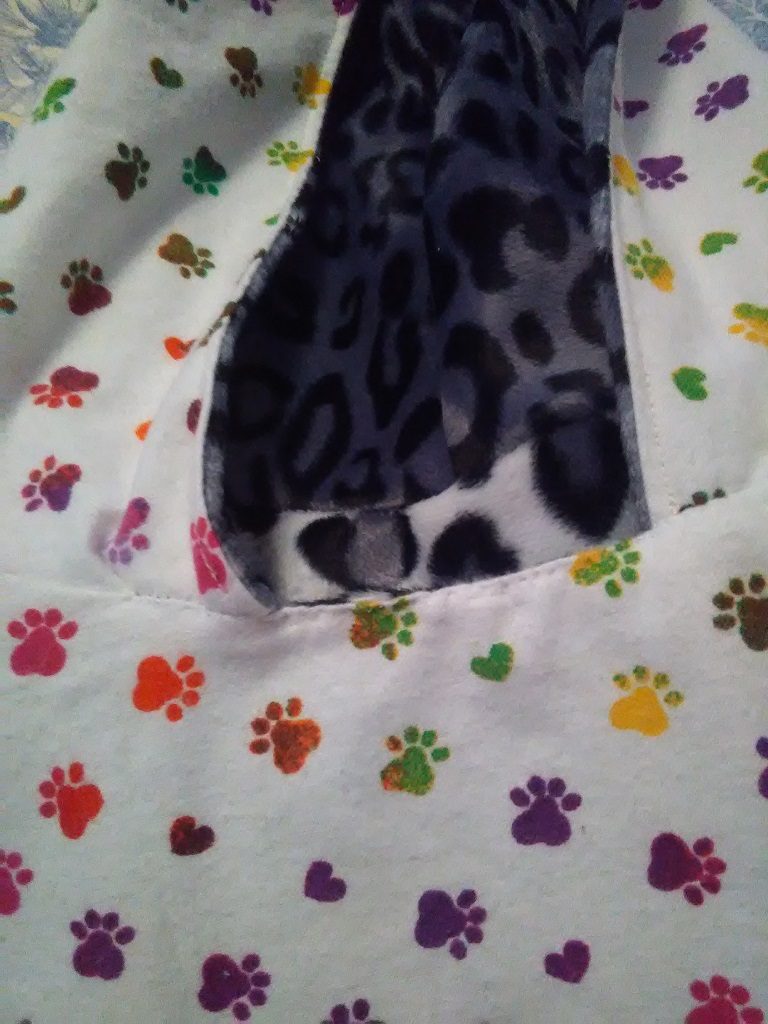
Baseball T-Shirt: Completed

I finished Anya’s baseball t-shirt!

I sketched a quick heart in Photoshop, and drew in two lines of baseball-style stitching. The image was printed on Transfer EZE ‘paper’ using our laser printer (which answered the question: can you laser print on this stuff?). I then took a little scrap of quilt batting and laid it on the shirt. Placed a scrap of white satin on top, then stuck the Transfer Eze print onto the satin. It adhered quite well to satin – was a little concerned!

Put it in a hoop and embroidered the red stitching to hold the whole thing in place. I then trimmed the satin about a quarter inch outside of the heart’s lines; the batting was trimmed to be about a quarter inch smaller than the satin. Finishing the project was just needle turn appliqueing the heart to the shirt (using what amounts to a really short satin stitch).

The quilt batting really enhances the stitch definition for the red lines, and it makes the whole design puff out a bit from the shirt.

PHP: Windows Authentication to MS SQL Database

I’ve encountered several people now how have followed “the directions” to allow their IIS-hosted PHP code to authenticate to a MS SQL server using Windows authentication … only to get an error indicating some unexpected ID is unable to log into the SQL server.

Create your application pool and add an identity. Turn off fastcgi.impersonate in your php.ini file. Create web site, use custom application pool … FAIL.

C:\Users\administrator.RUSHWORTH<%windir%\system32\inetsrv\appcmd.exe list config "Exchange Back End" /section:anonymousAuthentication
<system.webServer>
  <security>
    <authentication>
      <anonymousAuthentication enabled="true" userName="IUSR" />
    </authentication>
  </security>
</system.webServer>

The web site still doesn’t pick up the user from the application pool. Click on Anonymous Authentication, then click “Edit” over in the actions pane. Change it to use the application pool identity here too (why wouldn’t it automatically do so when an identity is provided?? no idea!).

C:\Users\administrator.RUSHWORTH<%windir%\system32\inetsrv\appcmd.exe list config "Exchange Back End" /section:anonymousAuthentication
<system.webServer>
  <security>
    <authentication>
      <anonymousAuthentication enabled="true" userName="" />
    </authentication>
  </security>
</system.webServer>

I’ve always seen the null string in userName, although I’ve read that the element may be omitted entirely. Once the site is actually using the pool identity, PHP can authenticate to SQL accounts using Windows authentication.

Baseball Shirt

Anya’s preschool class has “baseball day” on Friday, and they are to wear their baseball shirts. It’s an interesting assumption that everyone has a baseball shirt to wear. Three years ago, I happened across an Indians t-shirt on post-season clearance. It was a size too large, but she grows. Beyond my “you cannot go wrong with a 4$ t-shirt” purchase, we don’t have anything baseball related. I don’t particularly want to pay inflated MLB-licensed in-season (and the Indians are doing well) prices.

I picked up a bunch of blank t-shirts for embroidered designs, so I decided to make Anya a baseball themed shirt. She chose the green shirt, and I drew a heart and added baseball stitching. The black and white image was printed on this Transfer Eze paper that I love. Then I cut out a slightly larger heart of white satin and a same-sized heart from a very thin quilt batting. Laid out the t-shirt, centered the quilt backing, then affixed the Transfer Eze heart to the satin and laid it on top of the batting. Going with the quilting principal of working from the center out to avoid bubbles, I started with the red stitching. Now I’m using a satin stitch around the edge to needle turn appliqué the whole thing onto the t-shirt.

Precognition

how fucked up is our form of government when the passage of a bill rests on the author’s ability to craft perks for Alaska without specifically saying “Except for Alaska, which will get an extra fifty mill each year and the Department of Interior won’t accidentally lose all of their grant applications for the next three and a quarter years”?

Facebook’s Offensive Advertising Profiles

As a programmer, I assumed Facebook used some sort of statistical analysis to generate advertising categories based on user input rather than employing a marketing group. A statistical analysis of the phrases being typed is *generally* an accurate reflection of what people type, although I’ve encountered situations where their code does not appropriately weight adjectives (FB thought I was a Trump supporter because incompetent, misogynist, unqualified, etc didn’t clue them into my real beliefs). But I don’t think the listings causing an uproar this week were factually wrong.
 
Sure, the market segment name is offensive; but computers don’t natively identify human offense. I used to manage the spam filtering platform for a large company (back before hourly anti-spam definition updates were a thing). It is impossible to write every iteration of every potentially offensive string out there. We would get e-mails for \/|@GR@! As such, there isn’t a simple list of word combinations that shouldn’t appear in your marketing profiles. It would be quite limiting to avoid ‘kill’ or ‘hate’ in profiles too — a group of people who hate vegetables is a viable target market. Or those who make killer mods to their car.
 
FB’s failing, from a development standpoint, is not having a sufficiently robust set of heuristic principals against which target demo’s are analysed for non-publication. They may have considered the list would be self-pruning: no company is going to buy ads to target “kill all women”. Any advertising string that receives under some threshold of buys in a delta-time gets dropped. Lazy, but I’m a lazy programmer and could *totally* see myself going down that path. And spinning it as the most efficient mechanism at that. To me, this is the difference between a computer science major and an information sciences major. Computer science is about perfecting the algorithm to build categories from user input and optimizing the results by mining purchase data to determine which categories are worth retaining. Information science teaches you to consider the business impact of customers seeing the categories which emerge from user input. 
 
There are ad demo’s for all sorts of other offensive groups, so it isn’t like the algorithm unfairly targeted a specific group. Facebook makes money from selling advertisements to companies based on what FB users talk about. It isn’t a specific attempt to profit by advertising to hate groups; it’s an attempt to profit by dynamically creating marketing demographic categories and sorting people into their bins.
This isn’t limited to Facebook either – any scenario where it is possible to make money but costs nothing to create entries for sale … someone will write an algorithm to create passive income. Why WOULDN’T they? You can sell shirts on Amazon. Amazon’s Marketplace Web Service allows resellers to automate product listings. Custom write some code to insert random (adjectives | nouns | verbs) into a template string then throw together a PNG of the logo superimposed on a product. Have a production facility with an API to order, make the product once it has been ordered, and you’ve got passive income. And people did. I’m sure some were wary programmers – a sufficiently paranoid person might even have a human approve the new list of phrases. Someone less paranoid might make a banned word list (or even a banned word list and source one’s words from a dictionary and look for the banned words in the definition too). But a poorly conceived implementation will just glom words together and assume something stupid/offensive just won’t sell. Works that way sometimes. Bad publicity sinks the company other times.
 
The only thing that really offends me about this story is that unpleasant people are partaking in unpleasant conversations. Which isn’t news, nor is it really FB’s fault beyond creating a platform to facilitate the discussion. Possibly some unpleasant companies are targeting their ads to these individuals … although that’s not entirely FB’s fault either. Buy an ad in Breitbart and you can target a bunch of white supremacists too. Not creating a marketing demographic for them doesn’t make the belief disappear. 

Basic Security Or Paranoia

We have Amazon’s smart speakers, so I don’t know if this is true for Google or Apple digital assistants. But the Alexa series of speakers has a default wake word and several non-default options you can elect to use instead. Never use the default — that’s a good general security maxim. We had other factors in our wake word decision – a friend of Scott’s has a daughter whose name is quite close to Alexa and I foresaw the speaker going crazy if they’d speak of her. But the fact is, day 0 of the device … I expected advertisers to incorporate “Alexa, give me more info on product XYZ” in their ads. Aaaand now we have South Park season 21’s first episode.

This is just goofy stuff – maybe words you don’t want replaying at inopportune moments, maybe an alarm way too early in the morning for you. Remember TV commercials that asked kids to hold the telephone handset up to the screen and then played DTMF to ring the order hotline? Alexa, call 800-###-####. Hell, they could order Amazon products on your credit card. Something like ShopSafe (a unique card number with a low limit that actually rejects purchases over that limit) can be tied to your account. It’s extra work to keep updating the card on your account, but I’d rather Alexa buy 12$ of something I didn’t want than 250$. Then our speakers do not have unfettered access to my credit card – there’s a pin required to make purchases. I’m sure that won’t stop your kid who overhears the code from using it, but it prevents television programs, radio shows, and party-goers from buying random junk as a joke.

Checking Supported TLS Versions and Ciphers

There have been a number of ssl vulnerabilities (and deprecated ciphers that should be unavailable, especially when transiting particularly sensitive information). On Linux distributions, nmap includes a script that enumerates ssl versions and, per version, the supported ciphers.

[lisa@linuxbox ~]# nmap -P0 -p 25 –script +ssl-enum-ciphers myhost.domain.ccTLD

Starting Nmap 7.40 ( https://nmap.org ) at 2017-10-13 11:36 EDT
Nmap scan report for myhost.domain.ccTLD (#.#.#.#)
Host is up (0.00012s latency).
Other addresses for localhost (not scanned): ::1
PORT STATE SERVICE
25/tcp open smtp
| ssl-enum-ciphers:
| TLSv1.0:
| ciphers:
| TLS_ECDHE_RSA_WITH_AES_256_CBC_SHA (rsa 2048) – A
| TLS_DHE_RSA_WITH_AES_256_CBC_SHA (dh 2048) – A
| TLS_DHE_RSA_WITH_CAMELLIA_256_CBC_SHA (dh 2048) – A
| TLS_ECDHE_RSA_WITH_AES_128_CBC_SHA (rsa 2048) – A
| TLS_DHE_RSA_WITH_AES_128_CBC_SHA (dh 2048) – A
| TLS_DHE_RSA_WITH_CAMELLIA_128_CBC_SHA (dh 2048) – A
| TLS_RSA_WITH_AES_256_CBC_SHA (rsa 2048) – A
| TLS_RSA_WITH_CAMELLIA_256_CBC_SHA (rsa 2048) – A
| TLS_RSA_WITH_AES_128_CBC_SHA (rsa 2048) – A
| TLS_RSA_WITH_CAMELLIA_128_CBC_SHA (rsa 2048) – A
| compressors:
| NULL
| cipher preference: server
| TLSv1.1:
| ciphers:
| TLS_ECDHE_RSA_WITH_AES_256_CBC_SHA (rsa 2048) – A
| TLS_DHE_RSA_WITH_AES_256_CBC_SHA (dh 2048) – A
| TLS_DHE_RSA_WITH_CAMELLIA_256_CBC_SHA (dh 2048) – A
| TLS_ECDHE_RSA_WITH_AES_128_CBC_SHA (rsa 2048) – A
| TLS_DHE_RSA_WITH_AES_128_CBC_SHA (dh 2048) – A
| TLS_DHE_RSA_WITH_CAMELLIA_128_CBC_SHA (dh 2048) – A
| TLS_RSA_WITH_AES_256_CBC_SHA (rsa 2048) – A
| TLS_RSA_WITH_CAMELLIA_256_CBC_SHA (rsa 2048) – A
| TLS_RSA_WITH_AES_128_CBC_SHA (rsa 2048) – A
| TLS_RSA_WITH_CAMELLIA_128_CBC_SHA (rsa 2048) – A
| compressors:
| NULL
| cipher preference: server
| TLSv1.2:
| ciphers:
| TLS_ECDHE_RSA_WITH_AES_256_GCM_SHA384 (rsa 2048) – A
| TLS_DHE_RSA_WITH_AES_256_GCM_SHA384 (dh 2048) – A
| TLS_ECDHE_RSA_WITH_CHACHA20_POLY1305_SHA256 (rsa 2048) – A
| TLS_DHE_RSA_WITH_CHACHA20_POLY1305_SHA256 (dh 2048) – A
| TLS_DHE_RSA_WITH_AES_256_CCM_8 (dh 2048) – A
| TLS_DHE_RSA_WITH_AES_256_CCM (dh 2048) – A
| TLS_ECDHE_RSA_WITH_AES_128_GCM_SHA256 (rsa 2048) – A
| TLS_DHE_RSA_WITH_AES_128_GCM_SHA256 (dh 2048) – A
| TLS_DHE_RSA_WITH_AES_128_CCM_8 (dh 2048) – A
| TLS_DHE_RSA_WITH_AES_128_CCM (dh 2048) – A
| TLS_ECDHE_RSA_WITH_AES_256_CBC_SHA384 (rsa 2048) – A
| TLS_DHE_RSA_WITH_AES_256_CBC_SHA256 (dh 2048) – A
| TLS_ECDHE_RSA_WITH_CAMELLIA_256_CBC_SHA384 (rsa 2048) – A
| TLS_DHE_RSA_WITH_CAMELLIA_256_CBC_SHA256 (dh 2048) – A
| TLS_ECDHE_RSA_WITH_AES_128_CBC_SHA256 (rsa 2048) – A
| TLS_DHE_RSA_WITH_AES_128_CBC_SHA256 (dh 2048) – A
| TLS_ECDHE_RSA_WITH_CAMELLIA_128_CBC_SHA256 (rsa 2048) – A
| TLS_DHE_RSA_WITH_CAMELLIA_128_CBC_SHA256 (dh 2048) – A
| TLS_ECDHE_RSA_WITH_AES_256_CBC_SHA (rsa 2048) – A
| TLS_DHE_RSA_WITH_AES_256_CBC_SHA (dh 2048) – A
| TLS_DHE_RSA_WITH_CAMELLIA_256_CBC_SHA (dh 2048) – A
| TLS_ECDHE_RSA_WITH_AES_128_CBC_SHA (rsa 2048) – A
| TLS_DHE_RSA_WITH_AES_128_CBC_SHA (dh 2048) – A
| TLS_DHE_RSA_WITH_CAMELLIA_128_CBC_SHA (dh 2048) – A
| TLS_RSA_WITH_AES_256_GCM_SHA384 (rsa 2048) – A
| TLS_RSA_WITH_AES_256_CCM_8 (rsa 2048) – A
| TLS_RSA_WITH_AES_256_CCM (rsa 2048) – A
| TLS_RSA_WITH_AES_128_GCM_SHA256 (rsa 2048) – A
| TLS_RSA_WITH_AES_128_CCM_8 (rsa 2048) – A
| TLS_RSA_WITH_AES_128_CCM (rsa 2048) – A
| TLS_RSA_WITH_AES_256_CBC_SHA256 (rsa 2048) – A
| TLS_RSA_WITH_CAMELLIA_256_CBC_SHA256 (rsa 2048) – A
| TLS_RSA_WITH_AES_128_CBC_SHA256 (rsa 2048) – A
| TLS_RSA_WITH_CAMELLIA_128_CBC_SHA256 (rsa 2048) – A
| TLS_RSA_WITH_AES_256_CBC_SHA (rsa 2048) – A
| TLS_RSA_WITH_CAMELLIA_256_CBC_SHA (rsa 2048) – A
| TLS_RSA_WITH_AES_128_CBC_SHA (rsa 2048) – A
| TLS_RSA_WITH_CAMELLIA_128_CBC_SHA (rsa 2048) – A
| compressors:
| NULL
| cipher preference: server
|_ least strength: A

Nmap done: 1 IP address (1 host up) scanned in 144.67 seconds

Security Standards For Financial Information

A long time ago, processors of credit card information didn’t have any standards. And they’d lose your data. People didn’t like that, and some type of regulation had to be put on the industry. The credit card processors got together and formed an initiative to form their own regulations – PCI. They were a lot more concerned with the regulation’s impact on profitability than government regulations would have been. The PCI standards were fairly effective.

And now one of the credit bureaus has lost a huge amount of personal data – including social security numbers and account numbers that I don’t get why were stored in anything other than a one-way hash in the first place. But the bigger question is how are these credit bureaus able to operate with standards that are less strict than the industry-association generated PCI standards? My guess is that there will be a credit bureau industry association writing security standards in the next week or so. If there isn’t an industry association forming to ensure my social security number and account numbers aren’t stored in clear text on web-accessible servers at credit bureaus … I should hope the government would intervene and mandate a certain level of security.

Revisiting Court Decisions

In 2008, Miami-Dade enacted Ordinance 08-34 requiring cranes be able to withstand load from 140 mph winds. Construction companies objected — they’d need to spend more money ensuring public safety, and really how often are 140 mph winds ripping through Miami? Courts deemed the local regulation to cover worker safety and not public safety; the OSHA requirement, which is something like 90 mph, superseded the local government’s Ordinance (I think the 11th Circuit decision actually said it was a multi-purpose regulation … but since the requirement touched on workplace safety, OSHA wins). I wonder, as cranes come crashing into buildings in downtown Miami, if the court would revisit that decision.

I worked for a company that operated each regional area as an independent entity. Each had their own set of rules, regulations, processes … they just shared a common HR staff and all of the money rolled up to the same ledger. Their “sell” to this approach was that it allowed different regions with different requirements to make rules that met their customer’s needs. The unfortunate example that got cited, though, was a military base out in Virginia. *That* region had a policy where, upon being deployed overseas, a military family could have their account flagged as forward deployed. The the account would not be suspended for non-payment and no collections attempts would be made. Which is nice – but why weren’t military bases in other regions afforded the same courtesy? Or customers stationed at the base in Virginia who happened to retain their cell phone from their family’s home in Kansas? Essentially, I could never understand what about cellular service could need to be customized for a specific region where it was a completely unreasonable policy in other regions. There are areas where a single nation-wide regulation makes sense.

Construction regulations, on the other hand, seem very location specific. And a area where a nationwide minimum standard would be far more reasonable. I doubt there’s a lot of concern about coastal flooding in Denver. Snow load regulations for equipment in South Texas is silly, but I wouldn’t want to sleep next door to a crane in NYC that didn’t fall under some snow load reg. Builders in Maine don’t need to worry too much about tornado damage, but construction sites between OKC and Tulsa can reasonably be required to lash down their materials at the end of each day to avoid debris being flung all over the countryside. And, yeah, cities in Southern Florida can reasonably want large pieces of equipment to have higher wind load ratings than a crane in Seattle.

Furthermore — why is it “states rights” people only support the state’s rights to be *more* Republican? Why should Cali need a waiver to have stricter air quality and fuel efficiency rules? Why should Miami be unable to have higher standards for wind force? It isn’t like Washington needed a waiver to set their minimum wage above the federal set-point.