Browsers implement AIA which “helps” by repairing the certificate chain and forming a trust even without proper server configuration. Which is great for user experience, but causes a lot of challenges to people troubleshooting SSL connection failures from devices, old equipment, etc. It’s fine when I try it from my laptop!
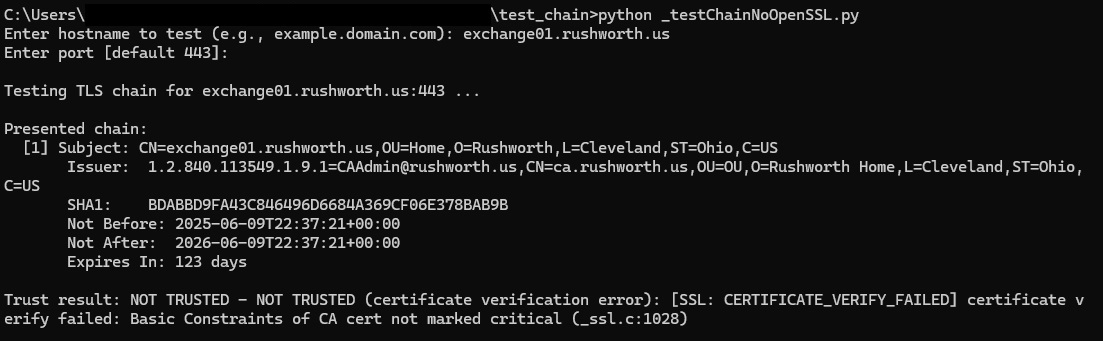
This python script reports on the real certificate chain being served from an endpoint. Self-signed certificates will show as untrusted
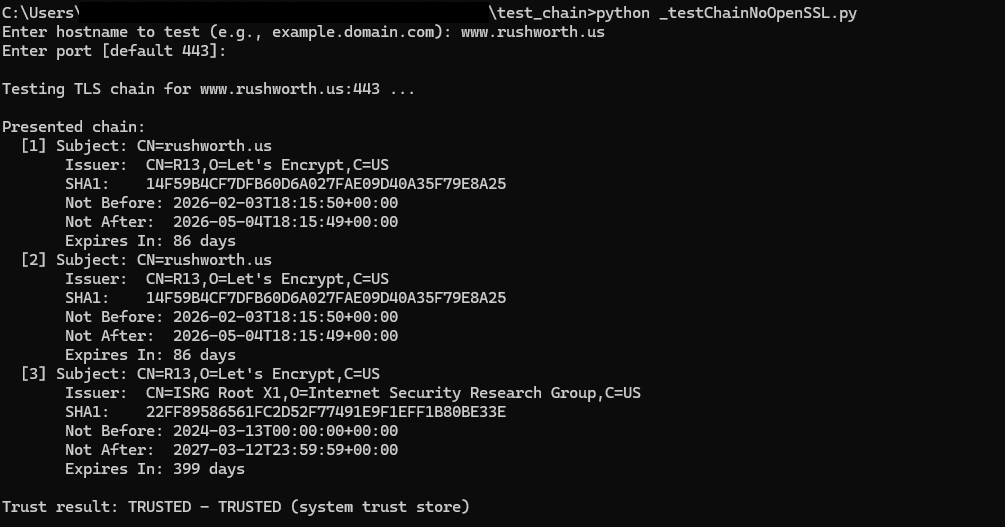
And public certs will show the chain and show as trusted
Code:
import ssl
import socket
import datetime
import select

# Third-party modules (install: pip install pyopenssl cryptography)
try:
    from OpenSSL import SSL, crypto
    from cryptography import x509
    from cryptography.hazmat.primitives import hashes
except ImportError as e:
    raise SystemExit(
        "Missing required modules. Please install:\n"
        "  pip install pyopenssl cryptography\n"
        f"Import error: {e}"
    )

def prompt(text, default=None):
    s = input(text).strip()
    return s if s else default

def check_trust(hostname: str, port: int, timeout=6.0):
    """
    Attempt a TLS connection using system trust store and hostname verification.
    Returns (trusted: bool, message: str).
    """
    try:
        ctx = ssl.create_default_context()
        with socket.create_connection((hostname, port), timeout=timeout) as sock:
            with ctx.wrap_socket(sock, server_hostname=hostname) as ssock:
                # Minimal HTTP GET to ensure we fully complete the handshake
                req = f"GET / HTTP/1.1\r\nHost: {hostname}\r\nConnection: close\r\n\r\n"
                ssock.sendall(req.encode("utf-8"))
                _ = ssock.recv(1)
        return True, "TRUSTED (system trust store)"
    except ssl.SSLCertVerificationError as e:
        return False, f"NOT TRUSTED (certificate verification error): {e}"
    except ssl.SSLError as e:
        return False, f"NOT TRUSTED (SSL error): {e}"
    except Exception as e:
        return False, f"Error connecting: {e}"

def _aware_utc(dt: datetime.datetime) -> datetime.datetime:
    """
    Ensure a datetime is timezone-aware in UTC. cryptography returns naive UTC datetimes.
    """
    if dt.tzinfo is None:
        return dt.replace(tzinfo=datetime.timezone.utc)
    return dt.astimezone(datetime.timezone.utc)

def _cert_to_info(cert: x509.Certificate):
    subj = cert.subject.rfc4514_string()
    issr = cert.issuer.rfc4514_string()
    fp_sha1 = cert.fingerprint(hashes.SHA1()).hex().upper()
    nb = _aware_utc(cert.not_valid_before_utc)
    na = _aware_utc(cert.not_valid_after_utc)
    now = datetime.datetime.now(datetime.timezone.utc)
    delta_days = max(0, (na - now).days)
    return {
        "subject": subj,
        "issuer": issr,
        "sha1": fp_sha1,
        "not_before": nb,
        "not_after": na,
        "days_to_expiry": delta_days
    }

def _do_handshake_blocking(conn: SSL.Connection, sock: socket.socket, timeout: float):
    """
    Drive the TLS handshake, handling WantRead/WantWrite by waiting with select.
    """
    deadline = datetime.datetime.now() + datetime.timedelta(seconds=timeout)
    while True:
        try:
            conn.do_handshake()
            return
        except SSL.WantReadError:
            remaining = (deadline - datetime.datetime.now()).total_seconds()
            if remaining <= 0:
                raise TimeoutError("TLS handshake timed out (WantRead)")
            r, _, _ = select.select([sock], [], [], remaining)
            if not r:
                raise TimeoutError("TLS handshake timed out (WantRead)")
            continue
        except SSL.WantWriteError:
            remaining = (deadline - datetime.datetime.now()).total_seconds()
            if remaining <= 0:
                raise TimeoutError("TLS handshake timed out (WantWrite)")
            _, w, _ = select.select([], [sock], [], remaining)
            if not w:
                raise TimeoutError("TLS handshake timed out (WantWrite)")
            continue

def fetch_presented_chain(hostname: str, port: int, timeout: float = 12.0):
    """
    Capture the presented certificate chain using pyOpenSSL.
    Returns (chain: list of {subject, issuer, sha1, not_before, not_after, days_to_expiry}, error: str or None).
    """
    # TCP connect
    try:
        sock = socket.create_connection((hostname, port), timeout=timeout)
        sock.settimeout(timeout)
    except Exception as e:
        return [], f"Error connecting: {e}"

    try:
        # TLS client context
        ctx = SSL.Context(SSL.TLS_CLIENT_METHOD)

        # Compatibility tweaks:
        # - Lower OpenSSL security level
        try:
            ctx.set_cipher_list(b"DEFAULT:@SECLEVEL=1")
        except Exception:
            pass

        # - Disable TLS 1.3 and set minimum TLS 1.2
        try:
            ctx.set_options(SSL.OP_NO_TLSv1_3)
        except Exception:
            pass
        try:
            # Ensure TLSv1.2+ (pyOpenSSL exposes set_min_proto_version on some builds)
            if hasattr(ctx, "set_min_proto_version"):
                ctx.set_min_proto_version(SSL.TLS1_2_VERSION)
        except Exception:
            pass

        # - Set ALPN to http/1.1 (some paths work better when ALPN is present)
        try:
            ctx.set_alpn_protos([b"http/1.1"])
        except Exception:
            pass

        conn = SSL.Connection(ctx, sock)
        conn.set_tlsext_host_name(hostname.encode("utf-8"))
        conn.set_connect_state()

        # Blocking mode (best effort)
        try:
            conn.setblocking(True)
        except Exception:
            pass

        # Drive handshake
        _do_handshake_blocking(conn, sock, timeout=timeout)

        # Retrieve chain (some servers only expose leaf)
        chain = conn.get_peer_cert_chain()
        infos = []
        if chain:
            for c in chain:
                der = crypto.dump_certificate(crypto.FILETYPE_ASN1, c)
                cert = x509.load_der_x509_certificate(der)
                infos.append(_cert_to_info(cert))
        else:
            peer = conn.get_peer_certificate()
            if peer is not None:
                der = crypto.dump_certificate(crypto.FILETYPE_ASN1, peer)
                cert = x509.load_der_x509_certificate(der)
                infos.append(_cert_to_info(cert))

        # Cleanup
        try:
            conn.shutdown()
        except Exception:
            pass
        finally:
            try:
                conn.close()
            except Exception:
                pass
            try:
                sock.close()
            except Exception:
                pass

        if not infos:
            return [], "No certificates captured (server did not present a chain and peer cert unavailable)"
        return infos, None

    except Exception as e:
        try:
            sock.close()
        except Exception:
            pass
        etype = type(e).__name__
        emsg = str(e) or "no message"
        return [], f"TLS handshake or chain retrieval error: {etype}: {emsg}"

def main():
    hostname = prompt("Enter hostname to test (e.g., example.domain.com): ")
    if not hostname:
        print("Hostname is required.")
        return
    port_str = prompt("Enter port [default 443]: ", "443")
    try:
        port = int(port_str)
    except ValueError:
        print("Invalid port.")
        return

    print(f"\nTesting TLS chain for {hostname}:{port} ...")
    chain, err = fetch_presented_chain(hostname, port)
    print("\nPresented chain:")
    if err:
        print(f"  [ERROR] {err}")
    elif not chain:
        print("  [No certificates captured]")
    else:
        for i, ci in enumerate(chain, 1):
            print(f"  [{i}] Subject: {ci['subject']}")
            print(f"       Issuer:  {ci['issuer']}")
            print(f"       SHA1:    {ci['sha1']}")
            nb_val = ci.get("not_before")
            na_val = ci.get("not_after")
            nb_str = nb_val.isoformat() if isinstance(nb_val, datetime.datetime) else str(nb_val)
            na_str = na_val.isoformat() if isinstance(na_val, datetime.datetime) else str(na_val)
            print(f"       Not Before: {nb_str}")
            print(f"       Not After:  {na_str}")
            dte = ci.get("days_to_expiry")
            if dte is not None:
                print(f"       Expires In: {dte} days")

    trusted, msg = check_trust(hostname, port)
    print(f"\nTrust result: {'TRUSTED' if trusted else 'NOT TRUSTED'} - {msg}")

if __name__ == "__main__":
    main()